
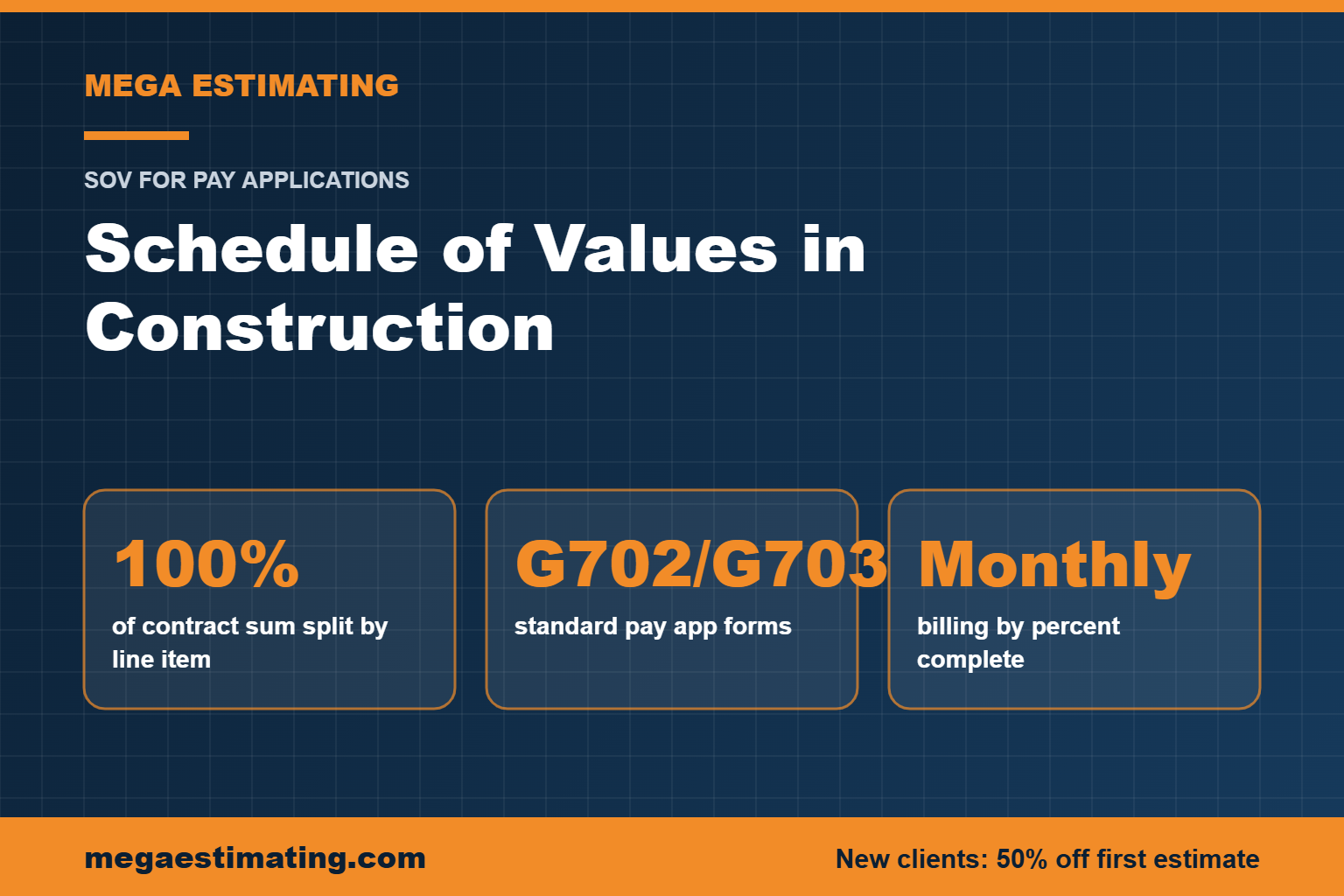
Getting paid on time is just as important as winning the bid. On most commercial jobs, every monthly payment is based on one document: the schedule of values in construction. A clear, balanced schedule of values makes pay applications fast to approve. A sloppy one leads to rejected invoices, slow cash flow and arguments over percent complete.
What a Schedule of Values Includes
- Item number and description for each scope, often by CSI division.
- Scheduled value: the dollar amount for that line. All lines add up to the contract sum.
- Work completed: previous and this period.
- Materials stored on site but not yet installed, if the contract allows billing for them.
- Percent complete, balance to finish and retainage.
On AIA contracts the SOV appears on the G703 Continuation Sheet, and the totals carry to the G702 Application and Certificate for Payment.
Sample Schedule of Values for a $1,000,000 Project
| # | Description | Scheduled Value | % of Total |
|---|---|---|---|
| 1 | General conditions | $80,000 | 8% |
| 2 | Sitework | $60,000 | 6% |
| 3 | Concrete | $150,000 | 15% |
| 4 | Masonry | $70,000 | 7% |
| 5 | Metals | $90,000 | 9% |
| 6 | Wood and carpentry | $110,000 | 11% |
| 7 | Thermal and moisture protection | $85,000 | 8.5% |
| 8 | Doors, windows and openings | $75,000 | 7.5% |
| 9 | Finishes | $120,000 | 12% |
| 10 | Mechanical, electrical and plumbing | $160,000 | 16% |
| Contract sum | $1,000,000 | 100% |
How the SOV Drives a Pay Application
In month one, the contractor finishes all sitework, 40% of concrete and 10% of general conditions:
| Line | Scheduled Value | % Complete | Completed to Date |
|---|---|---|---|
| General conditions | $80,000 | 10% | $8,000 |
| Sitework | $60,000 | 100% | $60,000 |
| Concrete | $150,000 | 40% | $60,000 |
| Total completed | $128,000 | ||
| Less 10% retainage | -$12,800 | ||
| Amount due this period | $115,200 | ||
Read more about how withheld amounts work in our guide to retainage in construction. Approved change orders are added as new lines, as explained in our change order guide.
How to Build a Schedule of Values
Step 1: Start From the Estimate
Use your detailed construction estimate grouped by trade or CSI division.
Step 2: Spread Overhead and Profit Fairly
Distribute markup across lines in proportion to cost rather than loading it into early items.
Step 3: Break Big Items Down
Split large scopes, for example concrete into footings, slab and walls, so progress is easier to measure.
Step 4: Match the Contract Format
Follow the owner’s required format and the rules in your contract, such as GMP or lump sum terms. See our guide to guaranteed maximum price contracts.
Step 5: Get It Approved Early
Submit the SOV right after award so the first pay application is not delayed.
Front-Loading and How to Avoid It
Front-loading means inflating early items such as mobilization or sitework so the contractor is paid ahead of progress. It helps cash flow short term, but owners, lenders and architects watch for it and may reject the SOV or reduce payments. A balanced SOV that tracks real cost builds trust and gets paid faster.
Common Schedule of Values Mistakes
- Lines too broad, making percent complete hard to agree on.
- Values that do not add up to the contract sum.
- Forgetting change orders as separate lines.
- Billing stored materials without the documents the contract requires.
- Ignoring retainage in cash flow planning.
Frequently Asked Questions
What is a schedule of values in construction?
A schedule of values is a list that breaks the total contract sum into line items for each part of the work. It is used to measure progress and bill monthly pay applications.
Who prepares the schedule of values?
The general contractor usually prepares it after contract award, and the owner or architect reviews and approves it before the first pay application.
What is front-loading a schedule of values?
Front-loading means putting too much value on early work items so the contractor is paid ahead of actual progress. Owners and lenders look for it and may reject the schedule.
How does retainage work with a schedule of values?
Retainage is a percentage, often 5 to 10 percent, held back from each payment based on work completed. It is released at substantial or final completion as the contract states.
Is the schedule of values the same as an estimate?
No. The estimate is how the contractor builds up cost and price. The schedule of values is how the agreed contract sum is divided for billing, though it is usually built from the estimate.
Need an Estimate That Turns Into a Clean SOV?
Mega Estimating prepares detailed, CSI-organized cost estimates that convert straight into a schedule of values for your pay applications. Mega Estimating is a U.S. construction estimating company that prepares quantity takeoffs and detailed cost estimates for residential, commercial and industrial contractors.
Get 50% Off Your First Estimate