
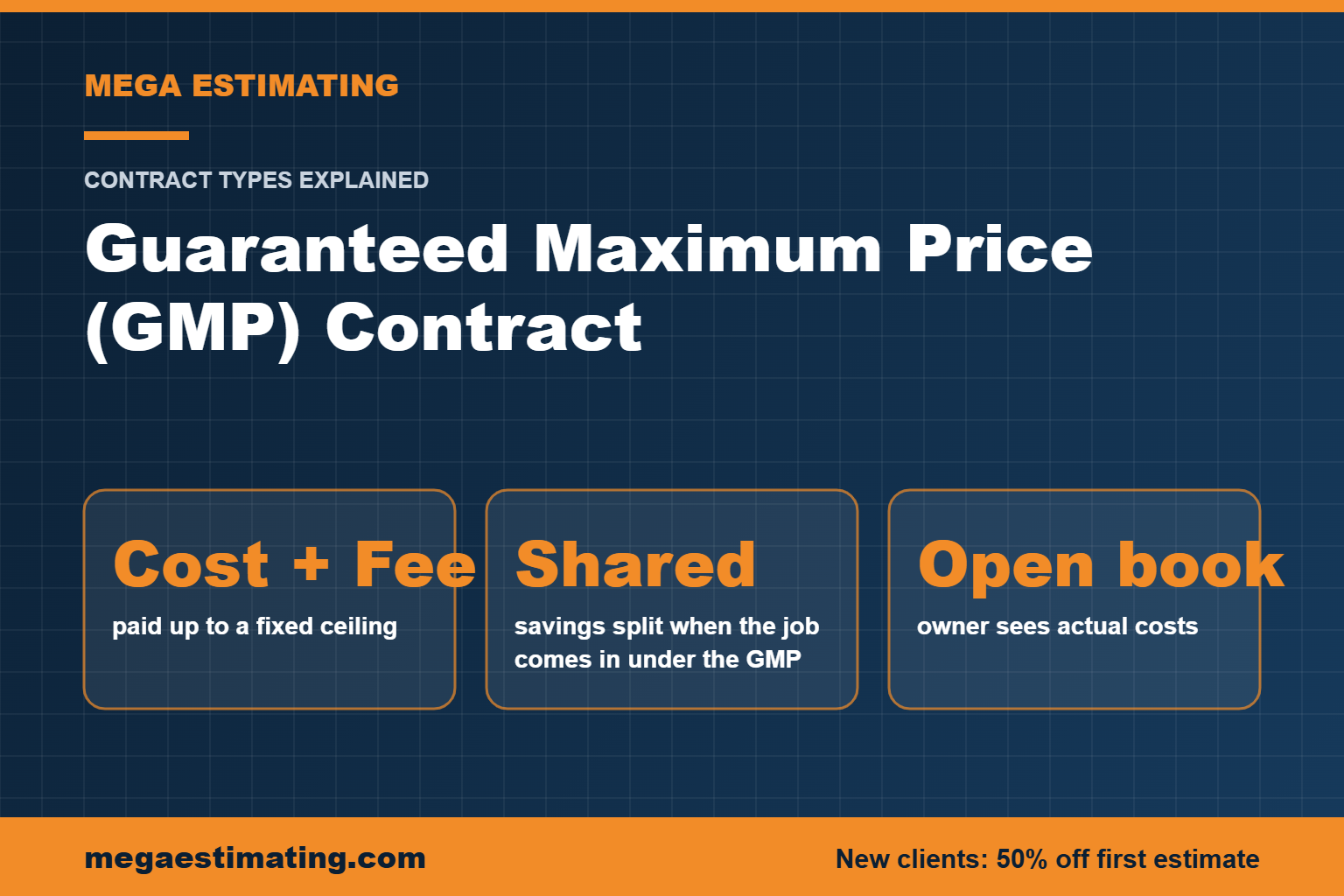
Owners want cost certainty, and contractors want to be paid for the work they actually do. The guaranteed maximum price contract, usually called a GMP, tries to give both. It is common on commercial, healthcare and institutional projects, especially with a construction manager at-risk. This guide explains how a GMP works, what goes into the number, and how to estimate it with an example.
How a GMP Contract Works
The contractor tracks every cost on an open-book basis: subcontracts, materials, equipment and its own staff on the job. The owner reimburses those costs plus an agreed fee, which is often a percentage. The total cannot exceed the guaranteed maximum price unless the owner approves a change order for added scope, unforeseen conditions or other events the contract allows. Standard forms such as the AIA cost-plus-fee agreement with a GMP and construction manager at-risk agreements set out these rules.
What Goes Into a GMP
| Component | What It Covers |
|---|---|
| Cost of the work | Subcontracts, materials, equipment and self-performed labor |
| General conditions | Site staff, temporary facilities, cleanup, safety and site logistics |
| Contractor’s contingency | Estimating gaps, buyout risk and coordination issues within the scope |
| Allowances | Items not fully designed yet, priced at a set amount |
| Insurance and bonds | Builder’s risk, liability and payment and performance bonds |
| Contractor’s fee | Overhead and profit, usually a percentage |
Owner contingency, for changes the owner makes, is usually held separately and is not part of the contractor’s GMP.
Worked GMP Example
A contractor prices a mid-size commercial building from design development drawings.
| Line | Calculation | Amount |
|---|---|---|
| Cost of the work | Subs, materials, equipment | $8,000,000 |
| General conditions | Staff, temporary facilities | $600,000 |
| Contractor contingency | 3% of $8,600,000 | $258,000 |
| Insurance and bonds | 1.5% of $8,858,000 | $132,870 |
| Fee | 4% of $8,990,870 | $359,635 |
| GMP | $9,350,505 |
If the final cost including fee comes to $9,050,000, the savings are $300,505. With a 75/25 owner/contractor split written in the contract, the owner keeps about $225,379 and the contractor earns about $75,126. If the cost had reached $9,500,000 without approved changes, the contractor would carry the $149,495 above the GMP. These percentages are only an illustration; real values come from each contract.
GMP vs Lump Sum vs Cost-Plus
| Contract Type | How the Contractor Is Paid | Who Carries Overrun Risk |
|---|---|---|
| Lump sum | One fixed price | Contractor |
| Cost-plus (no cap) | Actual cost plus fee | Owner |
| GMP | Actual cost plus fee, up to a cap | Mostly contractor above the cap |
| Unit price | Measured quantities times unit rates | Shared by quantity changes |
Pros and Cons of a GMP
For Owners
- A firm ceiling on cost, with visibility into every invoice.
- Potential savings if the job comes in under budget.
- The contractor can start early, before design is complete.
For Contractors
- Early involvement in design and better relationships with owners.
- A chance to share savings.
- Risk of absorbing overruns if the estimate or scope definition is weak.
- More reporting and audit work because of open books.
The quality of the estimate behind the GMP decides who wins. Our guides on preliminary cost estimates and retainage cover related cost and payment topics, and a budget estimate is often the first step toward a GMP.
Frequently Asked Questions
What is a guaranteed maximum price contract?
A GMP contract pays the contractor the actual cost of the work plus a fee, up to a fixed maximum price. Costs above that ceiling are generally the contractor’s responsibility, unless the scope changes.
Who pays if a GMP project goes over budget?
If the overrun is not caused by an owner change or another allowed adjustment, the contractor usually covers costs above the GMP.
What happens to savings under a GMP?
Savings below the GMP go to the owner or are shared between owner and contractor, based on the split written in the contract.
Is a GMP the same as a lump sum contract?
No. A lump sum contract pays a fixed price no matter the actual cost. A GMP pays actual cost plus fee up to a cap, with open-book accounting.
When is the GMP usually set?
Often during design, once drawings are developed enough to price, which is common on construction manager at-risk projects.
Build a GMP You Can Stand Behind
A GMP is only as safe as the estimate under it. Mega Estimating prepares detailed, CSI-organized estimates with clear assumptions, allowances and contingencies, from early budgets through final pricing. Mega Estimating is a U.S. construction estimating company that prepares quantity takeoffs and detailed cost estimates for residential, commercial and industrial contractors.
Get 50% Off Your First Estimate