
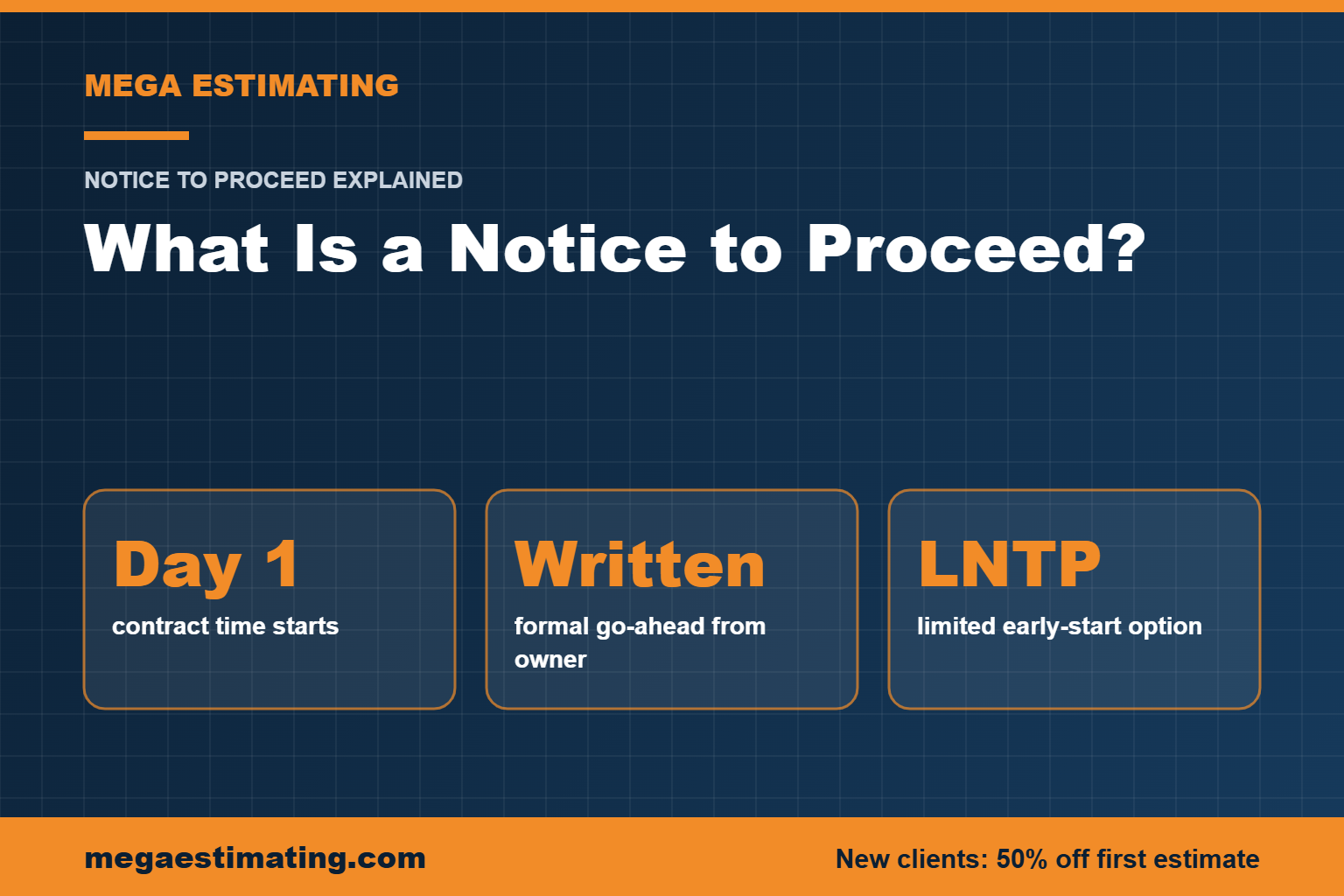
Winning the bid and signing the contract does not always mean you can start digging. On many projects, especially public and commercial work, the contractor waits for one more document: the notice to proceed. It is short, but it starts the clock on your schedule, your deadlines and often your liquidated damages exposure.
Where the Notice to Proceed Fits
| Stage | Document |
|---|---|
| 1. Bidding | Bid with bid bond if required |
| 2. Award | Notice of award or letter of intent |
| 3. Contract | Signed agreement, bonds and insurance |
| 4. Go-ahead | Notice to proceed |
| 5. Construction | Pay apps, RFIs, submittals, change orders |
What a Notice to Proceed Includes
- Project name and contract number
- Owner and contractor names
- Start date for the work or contract time
- Contract time or completion date, for example 180 calendar days
- Conditions or limits, such as permits or site access
- Signature of an authorized owner representative
Contract Time Example
| Item | Detail |
|---|---|
| NTP date | March 1 |
| Contract time | 180 calendar days |
| Substantial completion due | About August 27 or 28, depending on whether the contract counts the NTP date as day 1 |
| Liquidated damages (if in contract) | Start after the due date, at the daily rate in the contract |
Always read how your contract counts days: calendar days, working days, and whether the start date itself counts.
Limited Notice to Proceed (LNTP)
Sometimes the owner needs work to start before everything is final. A limited notice to proceed authorizes only specific early tasks, often with a dollar cap, such as:
- Design or preconstruction work
- Ordering long-lead equipment and materials
- Mobilization and site preparation
The full NTP follows later. Track LNTP costs separately so they can be billed against the right schedule of values lines.
What If the Notice to Proceed Is Delayed?
Bid prices assume a certain start window. If the NTP comes months late, material and labor prices can rise and seasonal work may shift into winter. Many contracts address this with a deadline for issuing the NTP or a right to adjust price or time. If yours does not, raise it in writing with the owner. A clear detailed estimate makes it easier to show what changed.
Common Notice to Proceed Mistakes
- Starting work on a verbal go-ahead.
- Not checking the start date written in the NTP.
- Ignoring LNTP cost caps.
- Planning the schedule from the bid date instead of the NTP.
- Missing conditions like permits that must be in place first.
Frequently Asked Questions
What is a notice to proceed in construction?
A notice to proceed (NTP) is a written notice from the owner telling the contractor it may start work. On most contracts, the contract time starts counting from the NTP date or a date stated in it.
Is a notice to proceed the same as a contract?
No. The contract sets the scope, price and terms. The NTP is the formal go-ahead that starts the clock under that contract.
What is a limited notice to proceed?
A limited notice to proceed (LNTP) authorizes only certain early work, such as design, ordering long-lead materials or mobilization, often with a cap on cost, before full NTP is issued.
Can a contractor start work before the NTP?
Starting without written authorization is risky. The contractor may not be paid for that work and may not be covered by the contract or its insurance and bonds.
What should a notice to proceed include?
Project name, contract reference, the start date, the contract time or completion date, and any conditions or limits, signed by an authorized owner representative.
Ready to Bid Your Next Project?
Before the NTP comes the winning bid. Mega Estimating prepares accurate takeoffs and detailed cost estimates so you can bid confidently and plan from day one. Mega Estimating is a U.S. construction estimating company that prepares quantity takeoffs and detailed cost estimates for residential, commercial and industrial contractors.
Get 50% Off Your First Estimate