
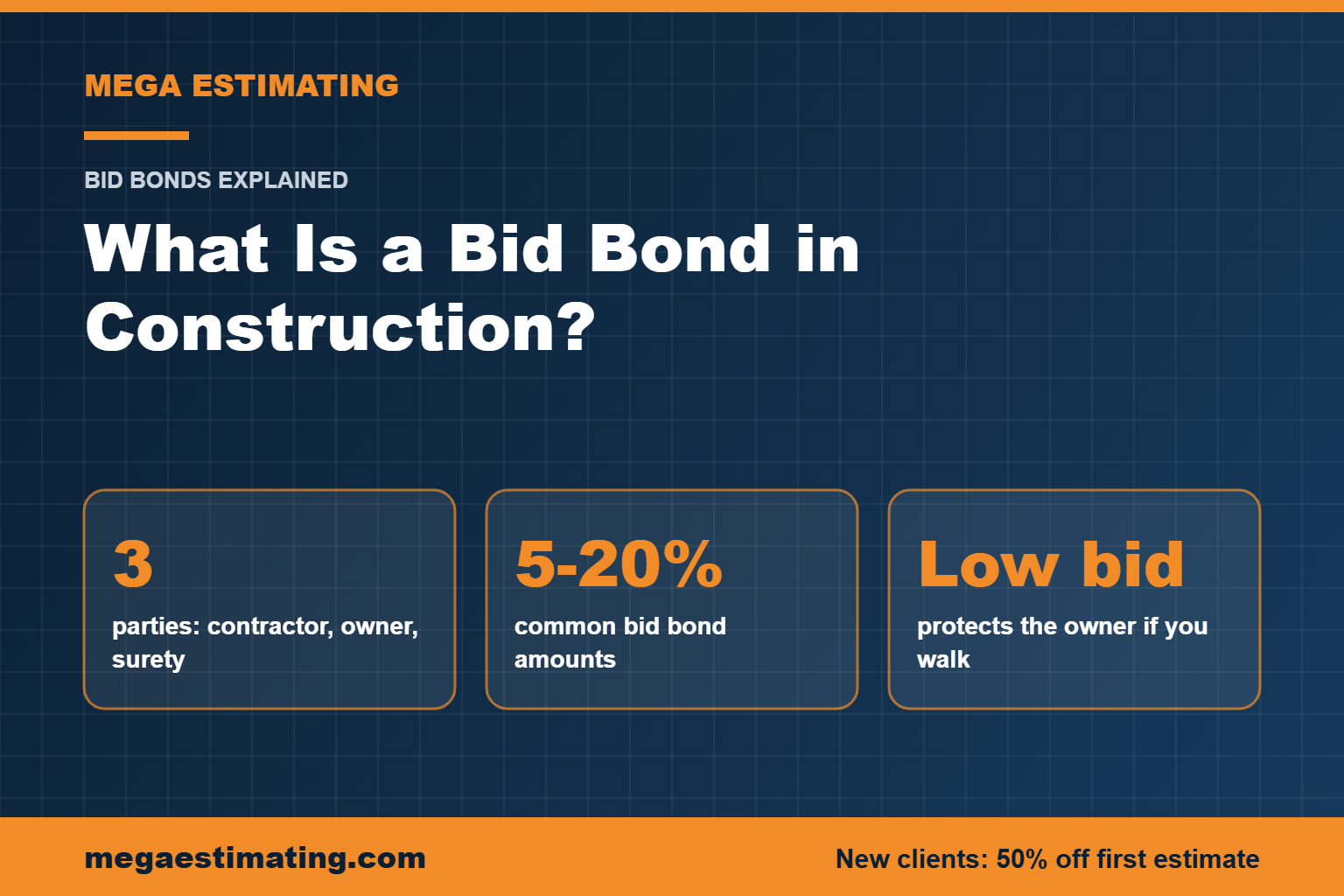
Many public and large private projects will not accept your bid without one thing attached: a bid bond. It tells the owner your number is serious and that you will sign the contract if you win. Understanding how bid bonds work, and what happens if your estimate has a mistake, helps you bid with confidence.
The Three Parties to a Bid Bond
| Party | Role |
|---|---|
| Principal | The contractor submitting the bid |
| Obligee | The project owner who requires the bond |
| Surety | The bonding company that guarantees the contractor’s promise |
How a Bid Bond Works Step by Step
Step 1: Owner Sets the Requirement
The bid documents state the bond amount, the form and the deadline.
Step 2: Contractor Gets the Bond
The surety issues the bond based on the contractor’s bonding capacity.
Step 3: Bond Is Submitted With the Bid
Bids without the required bond are usually rejected as non-responsive.
Step 4: Award or Release
If you win, you sign the contract and provide performance and payment bonds, and the bid bond is released. If you lose, the bond is simply released.
Step 5: Claim if the Winner Walks Away
If the low bidder refuses to sign, the owner can claim against the bond.
Bid Bond Amounts
| Project Type | Common Requirement |
|---|---|
| Many private and local public projects | 5% to 10% of the bid price |
| U.S. federal construction | Often 20% of the bid price, with a cap set in the solicitation |
| Owner-specific | Always follow the exact amount in the bid documents |
Many sureties issue bid bonds to established clients at low or no cost, because the real underwriting happens on the performance and payment bonds that follow.
Bid Bond Claim Example
| Item | Amount |
|---|---|
| Low bid | $2,000,000 |
| Bid bond required (10%) | $200,000 |
| Next acceptable bid | $2,120,000 |
| Owner’s extra cost if low bidder walks away | $120,000 |
| Typical claim (lesser of loss or bond amount) | $120,000 |
The surety pays the valid claim, then recovers it from the contractor under the indemnity agreement. Exact rules depend on the bond form and local law.
Bid Bond vs Performance Bond vs Payment Bond
| Bond | When | What It Guarantees |
|---|---|---|
| Bid bond | Bidding | You will sign the contract and provide the final bonds |
| Performance bond | After award | The work will be completed per the contract |
| Payment bond | After award | Subcontractors and suppliers will be paid |
Owners may also hold back retainage as added protection during the job.
How to Get a Bid Bond
- Work with a surety agent who specializes in construction.
- Prepare financials: CPA-prepared statements, work in progress and backlog.
- Show experience with similar project types and sizes.
- Build your bond line over time by completing bonded work successfully.
- Submit accurate bids using a solid bid template so you never need to walk away from a win.
Frequently Asked Questions
What is a bid bond in construction?
A bid bond is a surety bond submitted with a bid that guarantees the contractor will sign the contract and provide the required performance and payment bonds if their bid is accepted.
How much is a bid bond?
The bond amount is set in the bid documents, commonly 5 to 10 percent of the bid price on many projects and up to 20 percent on some public work. Sureties often issue bid bonds to established clients at little or no charge.
What happens if a contractor withdraws after winning?
The owner can claim on the bid bond, usually for the difference between the low bid and the next acceptable bid, up to the bond amount. The surety then seeks repayment from the contractor.
What is the difference between a bid bond and a performance bond?
A bid bond protects the owner during bidding. A performance bond protects the owner after award by guaranteeing the contractor will finish the work as the contract requires.
How do I get a bid bond?
Contact a surety agent or broker. The surety reviews your financial statements, work history, backlog and credit before issuing a bond line.
Bid With Confidence on Bonded Work
When a bond is on the line, your numbers must be right. Mega Estimating prepares accurate takeoffs and detailed cost estimates so you can bid public and private projects without costly surprises. Mega Estimating is a U.S. construction estimating company that prepares quantity takeoffs and detailed cost estimates for residential, commercial and industrial contractors.
Get 50% Off Your First Estimate