
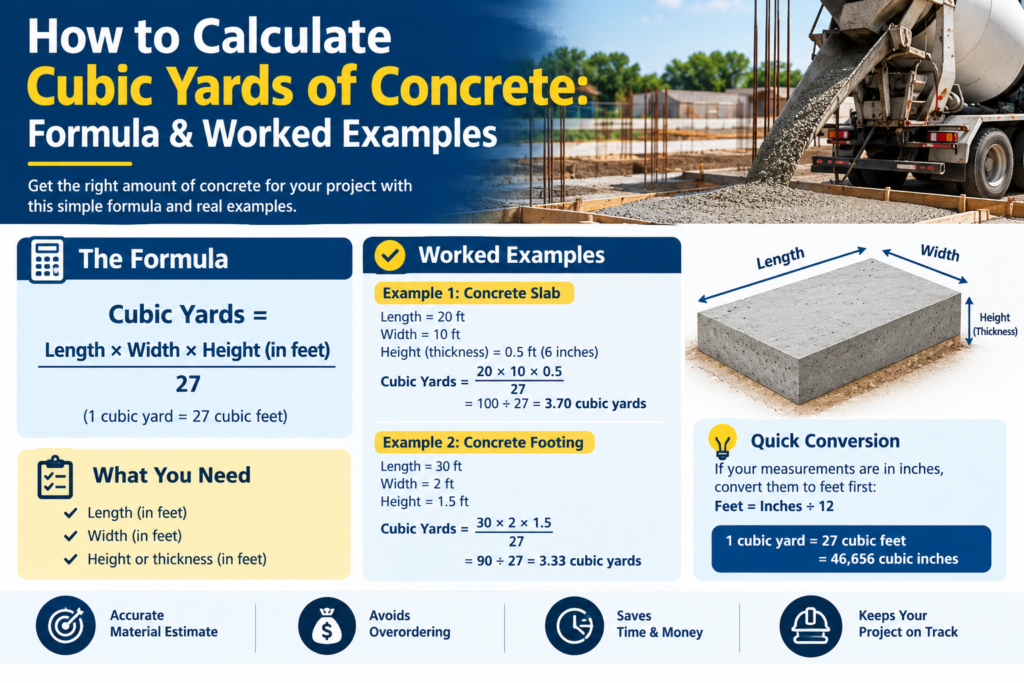
Knowing how to calculate cubic yards of concrete is the foundation of every pour. Order too little and you face a cold joint and an expensive second delivery. Order too much and you pay for concrete that ends up in the trash. This guide gives you the universal method, formulas for every common shape, ready-made charts, and seven worked examples, from a small patio to a full set of footings, walls and slabs.
Quick Answer
Cubic yards = Length (ft) × Width (ft) × Thickness (ft) ÷ 27
If your thickness is in inches, use this shortcut for a slab:
Cubic yards = Area (sq ft) × Thickness (in) ÷ 324
Then add 5-10% for waste. That is the whole method. The rest of this page shows you how to apply it to any shape.
Why Concrete Is Ordered in Cubic Yards
In the United States, ready-mix concrete is sold by the cubic yard. One cubic yard is a cube that measures 3 ft × 3 ft × 3 ft, which equals 27 cubic feet. Your drawings and field measurements are usually in feet and inches, so the work is converting to cubic feet first and then dividing by 27.
The Universal Method in 4 Steps
- Get every dimension in feet. Divide inches by 12 (6 inches = 0.5 ft, 4 inches = 0.333 ft).
- Calculate the volume in cubic feet using the right formula for the shape.
- Divide by 27 to convert to cubic yards.
- Add waste and round up to a sensible order size.
Unit Conversions to Keep Handy
| From | To | Multiply by |
|---|---|---|
| Inches | Feet | ÷ 12 |
| Cubic feet | Cubic yards | ÷ 27 |
| Cubic yards | Cubic feet | × 27 |
| Cubic yards | Cubic meters | × 0.7646 |
| Cubic meters | Cubic yards | × 1.308 |
Concrete Volume Formulas by Shape
| Shape | Volume (cubic feet) | Notes |
|---|---|---|
| Slab, wall, footing (rectangular) | Length × Width × Thickness | All in feet |
| Circular slab or column | 3.1416 × radius² × Height | Radius = diameter ÷ 2, in feet |
| Triangular slab | ½ × Base × Height × Thickness | Triangle area × thickness |
| L-shape or irregular area | Split into rectangles, calculate each, add | Add the results |
| Tapered footing or stepped surface | Calculate each section separately | Treat each part as its own box |
If your project has several elements, calculate each on its own, then add them. Never try to guess one number for the whole structure.
Worked Example 1: Rectangular Slab (8 × 10 ft, 4 Inches Thick)
- Area: 8 × 10 = 80 sq ft
- Volume: 80 × (4 ÷ 12) = 26.67 cu ft
- Cubic yards: 26.67 ÷ 27 = 0.99 cu yd
- Shortcut check: 80 × 4 ÷ 324 = 0.99 ✓
- With 10% waste: 0.99 × 1.10 = 1.09 cu yd
For small pours like this, many people use bagged mix. An 80 lb bag typically yields about 0.6 cu ft, so you need about 26.67 × 1.10 ÷ 0.6 = 49 bags. Check the yield printed on the bag, because it varies by product.
Worked Example 2: Circular Slab (12 ft Diameter, 4 Inches Thick)
- Radius: 12 ÷ 2 = 6 ft
- Area: 3.1416 × 6 × 6 = 113.1 sq ft
- Volume: 113.1 × (4 ÷ 12) = 37.70 cu ft
- Cubic yards: 37.70 ÷ 27 = 1.40 cu yd
- With 10% waste: 1.54 cu yd
Worked Example 3: Continuous Footing (20 in Wide × 10 in Deep × 120 ft Long)
- Width: 20 ÷ 12 = 1.667 ft
- Depth: 10 ÷ 12 = 0.833 ft
- Volume: 1.667 × 0.833 × 120 = 166.7 cu ft
- Cubic yards: 166.7 ÷ 27 = 6.17 cu yd
- With 10% waste: 6.79, so order about 7 cu yd
Footings are usually poured against dug earth, so the trench is rarely perfect. This is one of the places where a larger waste allowance is common. For more on footings, read our guide on how to calculate concrete for footings.
Worked Example 4: Foundation Stem Wall (8 in Thick × 4 ft Tall × 30 ft Long)
- Thickness: 8 ÷ 12 = 0.667 ft
- Volume: 30 × 4 × 0.667 = 80 cu ft
- Cubic yards: 80 ÷ 27 = 2.96 cu yd
- With 10% waste: 3.26, so order about 3.5 cu yd
If the wall has openings (windows, doors), subtract their volume only when they are large. Small openings are often ignored because they are offset by waste.
Worked Example 5: Four Round Piers (12 in Diameter × 4 ft Deep)
- Radius: 0.5 ft
- Volume of one pier: 3.1416 × 0.5 × 0.5 × 4 = 3.14 cu ft
- Four piers: 12.57 cu ft
- Cubic yards: 12.57 ÷ 27 = 0.47 cu yd
- With 10% waste: 0.51 cu yd
For several piers, use the quick-reference chart below instead of recalculating each time.
Worked Example 6: Solid Concrete Steps (3 Steps, 36 in Wide)
Each tread is 12 in deep and each rise is 7 in. For solid concrete steps, the volume is the width times the depth of each tread times the stacked height at that point.
- Heights at each step: 7, 14, 21 in. Total: 42 in = 3.5 ft
- Volume: 3 ft (width) × 1 ft (tread depth) × 3.5 ft = 10.5 cu ft
- Cubic yards: 10.5 ÷ 27 = 0.39 cu yd
- With 10% waste: 0.43 cu yd
Worked Example 7: Putting It Together (Small Garage Addition)
| Element | Volume (cu yd, before waste) |
|---|---|
| Footings (from Example 3) | 6.17 |
| Stem wall (from Example 4) | 2.96 |
| Slab, 20 × 20 ft × 4 in | 4.94 |
| Total | 14.07 |
| With 10% waste | 15.48 |
Order about 15.5 cubic yards. A standard mixer truck commonly carries somewhere around 8 to 10 cubic yards, so this would likely be two loads. Check capacity, partial-load fees and scheduling with your supplier before the pour day.
Slab Quick-Reference Chart
Cubic yards before waste.
| Slab size | 4 in | 5 in | 6 in |
|---|---|---|---|
| 10 × 10 ft (100 sq ft) | 1.23 | 1.54 | 1.85 |
| 10 × 12 ft (120 sq ft) | 1.48 | 1.85 | 2.22 |
| 12 × 12 ft (144 sq ft) | 1.78 | 2.22 | 2.67 |
| 20 × 20 ft (400 sq ft) | 4.94 | 6.17 | 7.41 |
| 20 × 24 ft (480 sq ft) | 5.93 | 7.41 | 8.89 |
| 24 × 24 ft (576 sq ft) | 7.11 | 8.89 | 10.67 |
Round Column and Pier Quick-Reference Chart
Cubic yards per foot of depth, before waste.
| Diameter | Cu yd per foot |
|---|---|
| 8 in | 0.013 |
| 10 in | 0.020 |
| 12 in | 0.029 |
| 16 in | 0.052 |
| 18 in | 0.065 |
Multiply by the depth in feet and by the number of piers. For example, six 16-inch piers at 5 ft deep: 0.052 × 5 × 6 = 1.56 cu yd.
How Much Waste Should You Add?
Real pours use more than the math says. Reasons include uneven subgrade, over-excavated trenches, forms that bow under pressure, spillage, and concrete left in the truck or pump.
- 5% for a level, well-prepared site with tight forms
- 10% for typical jobs
- More than 10% for rough excavations, stepped surfaces or hard-to-reach pours
Small differences add up. If a 480 sq ft slab averages half an inch thicker than planned, that is 20 extra cubic feet, or about 0.74 cubic yards you did not budget for.
Bags or Truck? How Many Bags Make a Cubic Yard
| Bag size | Typical yield | Bags per cubic yard |
|---|---|---|
| 80 lb | about 0.6 cu ft | about 45 |
| 60 lb | about 0.45 cu ft | about 60 |
Bagged concrete works well for small pours. As volume goes up, mixing by hand becomes slow and the pour is harder to keep continuous. Ready-mix trucks give a consistent batch, but small orders often carry minimum charges or short-load fees, so ask your supplier before you decide.
How Much Does a Cubic Yard of Concrete Weigh?
Normal-weight concrete weighs roughly 4,000 pounds per cubic yard. This matters for access, pump setup, truck routes and subgrade strength, especially with heavy trucks on soft ground or driveways.
Metric Conversion
If your drawings are in metric, calculate the volume in cubic meters (length × width × thickness in meters) and convert:
- Cubic yards = Cubic meters × 1.308
Many suppliers in metric regions order directly in cubic meters, so only convert when needed.
Spreadsheet Formulas You Can Copy
Put length in A2, width in B2, thickness in inches in C2, and waste (like 10%) in D2.
- Slab cubic yards:
=A2*B2*(C2/12)/27 - With waste:
=A2*B2*(C2/12)/27*(1+D2) - Circular, diameter in A2, thickness in inches in C2:
=PI()*(A2/2)^2*(C2/12)/27 - Cylinder, diameter in inches in A2, depth in feet in B2:
=PI()*(A2/24)^2*B2/27
Make one row per element and total the column. That gives you a basic concrete takeoff.
Common Mistakes When Calculating Concrete
- Mixing units. Using inches for one dimension and feet for the others makes the answer 12 times off.
- Forgetting to divide by 27. The result is cubic feet, not cubic yards.
- Skipping waste. Ordering exactly the calculated amount often leaves you short.
- Ignoring thickened edges and footings. Slabs with turned-down edges need extra volume.
- Not subtracting large voids, or subtracting small ones that are covered by waste anyway.
- Rounding down. Round up to the next ordering increment your supplier uses.
- Trusting one number for a complex project. Calculate each element separately.
From Hand Calculations to a Real Takeoff
Calculating one slab by hand is easy. A full project has footings, walls, slabs, columns, stairs and site concrete, all on different drawing sheets with different dimensions and details. That is a quantity takeoff. Read what a quantity takeoff is to see how the full process works, then how to estimate construction costs to see how quantities become prices.
If you work from plans, our blueprint estimating page explains how drawings are read for quantities. When you are ready to put prices to the volumes, use our construction bid template and our guide on how to bid a construction job. For more tools, browse our free construction estimate templates.
If you would rather hand the measuring off, our construction takeoff services and building cost estimating teams prepare concrete quantities and full cost estimates from your drawings. To turn the volume into dollars, see our concrete slab cost calculator for a worked pricing example.
Frequently Asked Questions
How do you calculate cubic yards of concrete?
Multiply length, width and thickness in feet to get cubic feet, then divide by 27. For slabs with the thickness in inches, area in square feet × thickness in inches ÷ 324 gives cubic yards directly.
How many cubic yards of concrete do I need for a 10 × 10 slab?
A 10 × 10 ft slab needs about 1.23 cubic yards at 4 inches thick, 1.54 at 5 inches and 1.85 at 6 inches, before waste.
How many square feet does a cubic yard of concrete cover?
It depends on thickness. A cubic yard covers about 81 sq ft at 4 inches, 65 sq ft at 5 inches and 54 sq ft at 6 inches, before waste.
How many bags of concrete are in a cubic yard?
About 45 bags of 80 lb mix, or about 60 bags of 60 lb mix, based on typical yields. Check the bag label.
How much extra concrete should I order?
Most contractors add 5-10%. Use a larger allowance for rough excavation, hard-to-form areas or hard-to-reach pours.
How do I convert cubic feet to cubic yards?
Divide by 27.
How much does one cubic yard of concrete weigh?
Roughly 4,000 pounds for normal-weight concrete.
Get Accurate Concrete Quantities for Your Project
Send us your plans and we will prepare a detailed quantity takeoff for footings, walls, slabs and everything else you need to price.
Related Guides
Let Mega Estimating Run Your Concrete Quantities
Manual yardage math works for one slab. For full foundations, walls and decks, our estimators calculate every pour from the drawings, add waste and rebar, and price the concrete package for your bid.
Mega Estimating is a U.S. construction estimating company that prepares quantity takeoffs, detailed cost estimates and bid support for residential, commercial and industrial contractors in all 50 states.
- Construction Takeoff Services
- Residential Estimating Services
- Concrete Slab Cost Calculator
- Concrete Estimating Software