
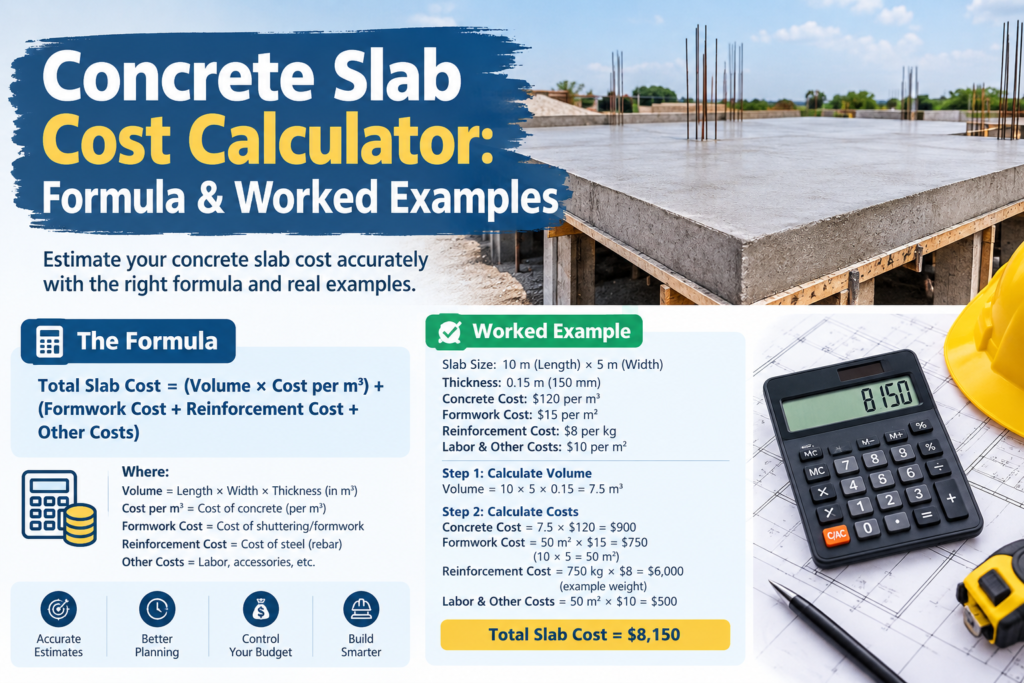
A concrete slab cost calculator turns three measurements (length, width and thickness) into the number of cubic yards you need, then into a total price once you add base, reinforcement, labor and waste. This guide gives you the formula, a quick-reference chart, a spreadsheet version you can copy, and two complete worked examples: a small patio and a garage slab with full pricing.
Quick Answer
Cubic yards = Length (ft) × Width (ft) × Thickness (in) ÷ 12 ÷ 27
Then add 5-10% for waste, multiply by your local price per cubic yard, and add everything else a slab needs: base, reinforcement, forms, finishing, equipment and delivery charges. The concrete itself is often only part of the total.
How a Concrete Slab Cost Calculator Works
Every calculator, online or in a spreadsheet, does the same five things:
- Measures the area of the slab
- Applies the thickness to get volume
- Converts the volume to cubic yards (how ready-mix concrete is sold)
- Adds a waste allowance
- Multiplies by unit prices and adds other costs
Once you understand these steps, you can check any online tool, and you can price slabs that don’t fit a tool’s simple rectangle.
Step 1: Measure the Slab Area
For a rectangle, multiply length by width in feet.
- Rectangle: Length × Width
- Circle: 3.1416 × radius × radius
- Triangle: ½ × base × height
- L-shapes and irregular slabs: split into rectangles, calculate each, then add them together
If you are working from drawings instead of the site, take the dimensions from the foundation or site plan. Our blueprint estimating work covers how to read those sheets for quantities.
Step 2: Choose the Slab Thickness
Thickness has a large effect on volume. Common guidance is:
| Use | Typical thickness |
|---|---|
| Walkways, patios, light-duty slabs | 4 in |
| Driveways and garage floors with cars | 4-6 in |
| Heavier loads, trucks, equipment | 6 in or more, usually designed by an engineer |
These are typical starting points, not design values. Check the drawings, local code and the engineer’s specification. Always convert inches to feet when calculating (4 inches = 4 ÷ 12 = 0.333 ft).
Step 3: Convert Volume to Cubic Yards
Ready-mix concrete is ordered by the cubic yard, and one cubic yard equals 27 cubic feet.
- Volume (cu ft) = Area (sq ft) × Thickness (in) ÷ 12
- Cubic yards = Volume (cu ft) ÷ 27
For a deeper look at this conversion on other shapes, see our guide on how to calculate cubic yards of concrete.
Step 4: Add a Waste Allowance
Real slabs use more concrete than the math says. The subgrade is never perfectly flat, forms bow slightly, and some concrete is lost to spillage and leftover in the truck.
A common allowance is 5% for a very level, well-prepared site and 10% for a typical job. Larger allowances may be needed for uneven ground.
Here is how fast small variations add up. If a 480 sq ft slab ends up an average of half an inch thicker than planned, that is 480 × 0.5 ÷ 12 = 20 cubic feet, or about 0.74 cubic yards of extra concrete you did not budget for.
Concrete Volume Quick-Reference Chart
These figures show cubic yards before waste.
| Slab size | 4 in thick | 5 in thick | 6 in thick |
|---|---|---|---|
| 10 × 10 ft (100 sq ft) | 1.23 | 1.54 | 1.85 |
| 10 × 12 ft (120 sq ft) | 1.48 | 1.85 | 2.22 |
| 12 × 12 ft (144 sq ft) | 1.78 | 2.22 | 2.67 |
| 20 × 20 ft (400 sq ft) | 4.94 | 6.17 | 7.41 |
| 20 × 24 ft (480 sq ft) | 5.93 | 7.41 | 8.89 |
| 24 × 24 ft (576 sq ft) | 7.11 | 8.89 | 10.67 |
Rule of thumb: every 100 sq ft needs about 1.23 cubic yards at 4 inches, 1.54 at 5 inches and 1.85 at 6 inches.
Bagged Concrete or Ready-Mix?
For very small slabs, bagged mix can make sense. An 80 lb bag typically yields about 0.6 cubic feet, so a cubic yard takes roughly 45 bags. Check the yield printed on the bag you buy, because it varies by product.
- Bagged mix: practical for small pads and repairs. Mixing and placing by hand gets hard and slow beyond that.
- Ready-mix truck: better for larger slabs, since mixing in one batch gives consistent strength and a continuous pour. Ask your supplier about minimum order sizes and short-load fees, because small orders often cost more per yard.
Step 5: Price the Whole Slab, Not Just the Concrete
A slab cost calculator that only multiplies cubic yards by a price will undercount. Include each of these:
| Cost item | How to calculate |
|---|---|
| Ready-mix concrete | Cubic yards ordered × price per yard |
| Gravel base | Base area × depth ÷ 12 ÷ 27, plus waste, × price per yard |
| Vapor barrier | Area × price per sq ft |
| Reinforcement (mesh or rebar) | Area × price per sq ft, or count and length of bars. See how to calculate rebar for a slab |
| Forms, joints, curing | Lump sum or per linear foot |
| Labor (prep, forming, placing, finishing) | Area × labor rate per sq ft, or crew hours × crew cost |
| Equipment | Compactor, pump, saw-cutting and similar |
| Delivery and fees | Short-load, pump, travel and permit charges |
| Overhead and profit | Percentage applied to the subtotal |
If your slab has thickened edges or sits on a footing, calculate those separately. Our guide to how to calculate concrete for footings shows how.
Worked Example 1: 10 × 10 ft Patio, 4 Inches Thick
Volume
- Area: 10 × 10 = 100 sq ft
- Volume: 100 × 4 ÷ 12 = 33.33 cu ft
- Cubic yards: 33.33 ÷ 27 = 1.23 cu yd
Add 10% waste
- 1.23 × 1.10 = 1.36 cu yd
What to order
- Ready-mix: about 1.5 cubic yards (ask your supplier about short-load fees)
- Bagged mix: 33.33 × 1.10 = 36.7 cu ft ÷ 0.6 = about 62 bags of 80 lb
Worked Example 2: 20 × 24 ft Garage Slab, 5 Inches Thick, With Full Pricing
Important: the unit prices below are placeholders for the example only, not market prices. Replace each one with your own supplier quotes and local labor rates.
Volume
- Area: 20 × 24 = 480 sq ft
- Volume: 480 × 5 ÷ 12 = 200 cu ft
- Cubic yards: 200 ÷ 27 = 7.41 cu yd
- With 10% waste: 8.15, rounded up to 8.5 cu yd to order
Gravel base (4 in compacted)
- 480 × 4 ÷ 12 = 160 cu ft ÷ 27 = 5.93 cu yd, plus 10% = about 6.5 cu yd
Cost table (example unit prices)
| Item | Quantity | Example unit price | Amount |
|---|---|---|---|
| Ready-mix concrete | 8.5 cu yd | $160 / cu yd | $1,360.00 |
| Gravel base | 6.5 cu yd | $45 / cu yd | $292.50 |
| Reinforcement | 480 sq ft | $0.75 / sq ft | $360.00 |
| Vapor barrier | 480 sq ft | $0.15 / sq ft | $72.00 |
| Forms, joints, curing | Lump sum | $250.00 | |
| Labor (prep, place, finish) | 480 sq ft | $4.50 / sq ft | $2,160.00 |
| Equipment rental | Lump sum | $150.00 | |
| Direct cost subtotal | $4,644.50 | ||
| Overhead and profit (20%) | $928.90 | ||
| Total | $5,573.40 | ||
| Cost per sq ft | $5,573.40 ÷ 480 | $11.61 |
The takeaway is the method. The final number depends entirely on your local prices, access, finish and design. Two slabs of the same size can vary a lot in price.
Spreadsheet Formula You Can Copy
Put length in A2, width in B2, thickness in inches in C2, waste percentage (like 10%) in D2, and price per cubic yard in E2. Then use:
- Cubic yards (no waste):
=A2*B2*(C2/12)/27 - Cubic yards to order:
=A2*B2*(C2/12)/27*(1+D2) - Concrete cost:
=A2*B2*(C2/12)/27*(1+D2)*E2
Add rows underneath for base, reinforcement, labor and the rest, so the sheet becomes a basic estimate rather than just a volume checker.
What Makes a Slab Cost More
Several factors push the real cost above a simple calculator result:
- Mix design: higher strength, air entrainment and special additives
- Site access: a pump truck, long hauls, steep slopes or tight sites
- Excavation and base preparation: poor soil, drainage and compaction needs
- Finish: broom, trowel, stamped or colored surfaces
- Reinforcement and joints: heavier rebar, dowels and more control joints
- Season and weather: hot or cold weather protection, curing methods
- Region and labor rates: costs differ a lot by market. In dense, expensive markets such as New York, they run well above national averages. See our NYC construction cost per square foot guide for how local conditions change budgets
- Order size: small orders often carry minimum charges
If you are budgeting a driveway rather than a building slab, read our cost to pour a concrete driveway guide, which covers the additional items driveways bring.
Common Mistakes With Slab Calculations
- Mixing units. Leaving thickness in inches while length and width are in feet gives an answer that is 12 times too large.
- Skipping waste. Ordering exactly the calculated yardage often leaves you short.
- Pricing only the concrete. Base, reinforcement, forming, labor and equipment are often as large as the concrete line.
- Ignoring thickened edges and footings. These add real volume.
- Assuming the subgrade is level. A half-inch of extra thickness over a large slab adds a lot.
- Forgetting minimum order and short-load fees. Small orders cost more per yard.
- Treating the calculator number as a bid. A calculator gives a rough budget. A bid also needs risk, overhead, profit and scope exclusions.
From Calculator to Real Estimate
A calculator is useful for early budgeting and checking quotes. When the slab is part of a larger project, you need a complete quantity takeoff that measures every slab, footing, wall and edge from the drawings, and then prices them correctly. To understand how that works, read what a quantity takeoff is, our guide to how to estimate construction costs, and the basics of preliminary cost estimates for early-stage budgets.
When you are ready to turn quantities into a bid, our construction bid template shows the format, with a filled sample. If measuring and pricing is taking too much of your time, our construction takeoff services can prepare concrete quantities from your plans, and our building cost estimating team can price the full project. You can also browse our free construction estimate templates.
Frequently Asked Questions
How do you calculate the cost of a concrete slab?
Calculate the volume in cubic yards (length × width × thickness in inches ÷ 12 ÷ 27), add 5-10% for waste, then multiply by your price per cubic yard. Add the base, reinforcement, forms, labor, equipment and fees to get the full slab cost.
How many cubic yards of concrete do I need for a 10 × 10 slab?
A 10 × 10 ft slab needs about 1.23 cubic yards at 4 inches thick, 1.54 at 5 inches and 1.85 at 6 inches, before adding waste.
How thick should a concrete slab be?
Patios and walkways are commonly 4 inches. Driveways and garage floors are often 4 to 6 inches. Heavier loads need a thicker, engineered slab, so always follow your drawings and local code.
How many bags of concrete make a cubic yard?
About 45 bags of 80 lb mix, based on a typical yield of 0.6 cubic feet per bag. Check the yield on the bag you buy.
How much extra concrete should I order?
Most contractors add 5-10% on top of the calculated volume to cover uneven subgrade, spillage and form movement.
Is a slab calculator accurate enough for a bid?
It is good for rough budgets and for checking numbers. For a bid, use a measured quantity takeoff from the drawings, current supplier quotes, local labor rates and your own overhead and profit.
Get Your Concrete Quantities Done Right
Send us your plans and we will prepare a detailed quantity takeoff and cost estimate for slabs, footings and the rest of your project.
Related Guides
Need a Full Slab Estimate?
A calculator gives a starting number. Mega Estimating prices the whole slab scope, including subgrade, vapor barrier, reinforcement, placement, finishing and curing, with local material and labor rates.
Mega Estimating is a U.S. construction estimating company that prepares quantity takeoffs, detailed cost estimates and bid support for residential, commercial and industrial contractors in all 50 states.
- Construction Takeoff Services
- Commercial Estimating Services
- How to Calculate Cubic Yards of Concrete
- What Is Site Preparation in Construction?