
Gravel is ordered by the cubic yard or by the ton, but driveways, patios and drainage trenches are measured in feet and inches. If you are asking how much gravel do I need, the math takes three steps: find the volume, convert it to cubic yards, then convert to tons. This guide walks through each step with charts and a full driveway example.
How to Calculate Gravel in 3 Steps
Step 1: Find the Volume in Cubic Feet
Multiply length by width by depth. Convert depth from inches to feet by dividing by 12, so 4 inches is 0.333 ft and 6 inches is 0.5 ft.
Step 2: Convert to Cubic Yards
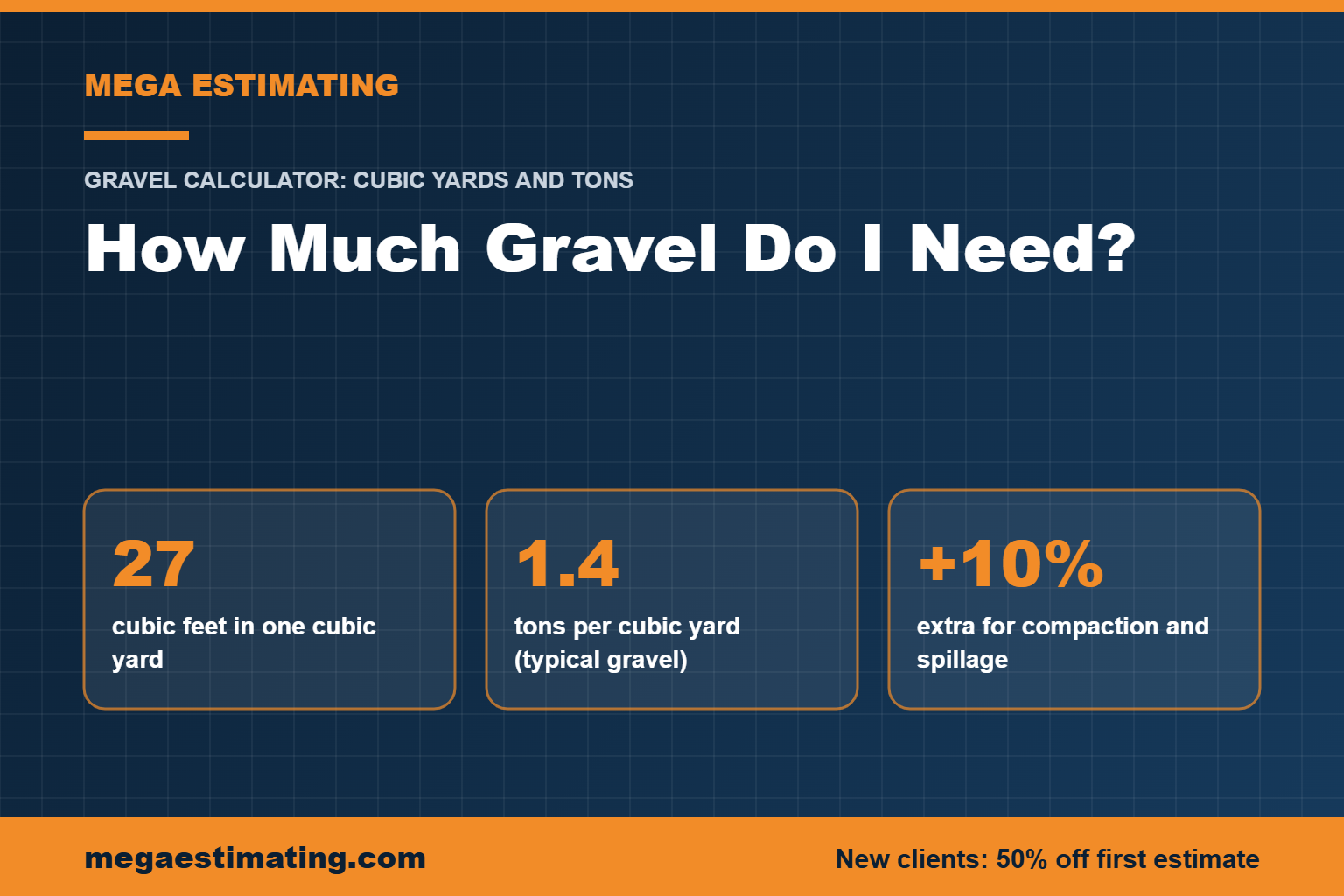
Divide cubic feet by 27, since one cubic yard is 3 x 3 x 3 feet.
Step 3: Convert to Tons
Multiply cubic yards by the weight of your gravel. Most crushed stone and gravel weigh about 1.3 to 1.5 tons per cubic yard; 1.4 is a good average. Add 10% to cover compaction and spillage.
How Deep Should Gravel Be?
| Use | Typical Depth |
|---|---|
| Garden paths and decorative cover | 2 – 3 in |
| Walkways | 3 – 4 in |
| Patio and paver base | 4 – 6 in |
| Shed or slab base | 4 – 6 in |
| Gravel driveway | 6 – 12 in in layers |
| French drain or pipe bedding | Per trench detail |
Gravel Chart per 100 Square Feet
Figures below are for 100 square feet before the 10% extra. Multiply for larger areas.
| Depth | Cubic Feet | Cubic Yards | Tons (at 1.4) |
|---|---|---|---|
| 2 in | 16.7 | 0.62 | 0.86 |
| 3 in | 25.0 | 0.93 | 1.30 |
| 4 in | 33.3 | 1.23 | 1.73 |
| 6 in | 50.0 | 1.85 | 2.59 |
Worked Example: A 12 x 50 ft Gravel Driveway
| Item | Calculation | Result |
|---|---|---|
| Volume | 12 x 50 x 0.5 ft | 300 cu ft |
| Cubic yards | 300 ÷ 27 | 11.1 cu yd |
| Tons | 11.1 x 1.4 | 15.6 tons |
| With 10% extra | 15.6 x 1.10 | about 17 tons |
A standard tandem dump truck usually carries 13 to 15 tons, so this driveway is about two truckloads. See our guide on dump truck capacity for load planning.
Gravel Types and Typical Weights
| Material | Common Use | Approx. Tons per Cu Yd |
|---|---|---|
| Crushed stone (#57) | Driveways, drainage, slab base | 1.35 – 1.5 |
| Crusher run / road base | Compacted base under pavers and slabs | 1.4 – 1.6 |
| Pea gravel | Paths, play areas, landscaping | 1.3 – 1.4 |
| River rock | Decorative beds, drainage | 1.3 – 1.5 |
Weights vary by quarry and moisture, so always confirm with the supplier before ordering by the ton.
Common Gravel Estimating Mistakes
- Using inches in the formula. Convert depth to feet first.
- Ignoring compaction. Compacted base shrinks, so order extra.
- Mixing yards and tons. Check whether your supplier sells by volume or weight.
- Skipping excavation. Removing soil for the base is a separate cost; see site preparation in construction.
- Forgetting fabric and edging. Geotextile and edging keep gravel in place.
Building a patio on that base? Our paver calculator guide covers the pavers, sand and edging.
Frequently Asked Questions
How much gravel do I need for 100 square feet?
At 4 inches deep, 100 square feet needs about 1.23 cubic yards, which is roughly 1.7 tons of typical gravel. At 2 inches it is about 0.62 cubic yards.
How many tons of gravel are in a cubic yard?
Most gravel and crushed stone weighs about 1.3 to 1.5 tons per cubic yard. Use 1.4 tons as a working average and confirm with your supplier.
How deep should gravel be for a driveway?
Most gravel driveways use 6 to 12 inches of stone placed in layers, with a larger base stone below and a finer top layer.
How much extra gravel should I order?
Add about 10% for compaction and spillage, and up to 15% when the base will be compacted heavily or the subgrade is uneven.
How many bags of gravel equal a cubic yard?
A cubic yard is 27 cubic feet, so it takes about 54 bags of 0.5 cubic foot gravel to make one cubic yard.
Need Sitework Quantities for a Full Project?
Large sites need cut and fill, base courses, paving and drainage measured from civil drawings. Mega Estimating calculates every layer in cubic yards and tons and prices it for your bid. Mega Estimating is a U.S. construction estimating company that prepares quantity takeoffs and detailed cost estimates for residential, commercial and industrial contractors.
Get 50% Off Your First Estimate