
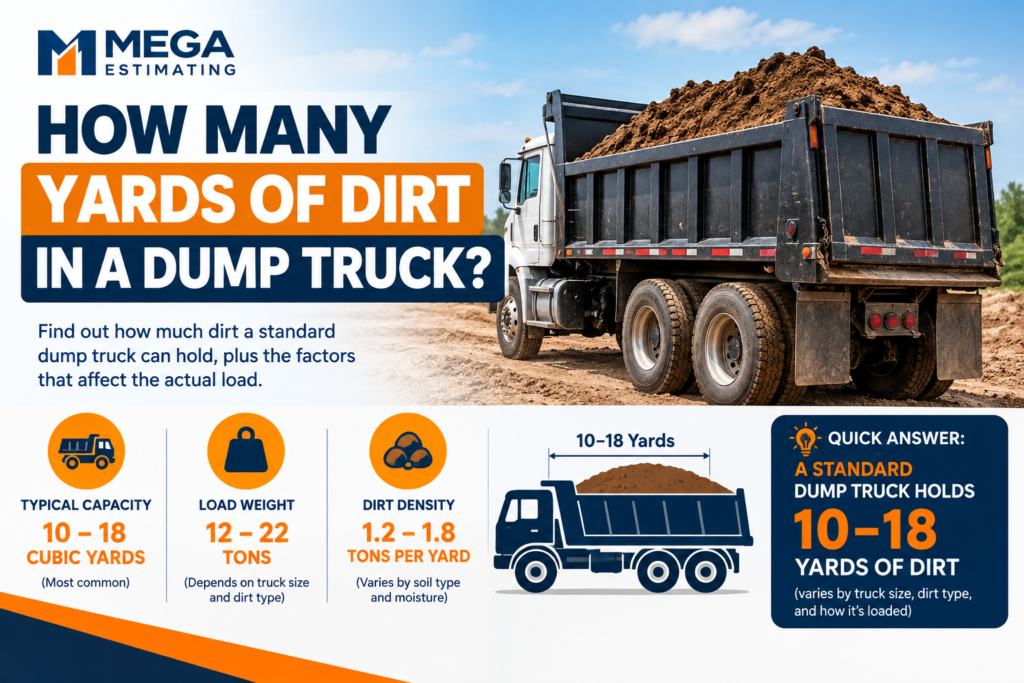
This guide gives you typical truck capacities, explains weight limits and swell, and shows how to estimate the number of loads for a real job.
Dump Truck Capacity by Truck Size
Capacities vary by body size, local weight laws and how high the load is heaped. These are typical ranges for dirt in the United States:
| Truck Type | Typical Dirt Volume | Typical Payload | Common Use |
|---|---|---|---|
| Full-size pickup | 1 – 2 cu yd | 1 – 1.5 tons | Small garden or repair jobs |
| Small dump (1-ton class) | 2 – 3 cu yd | 2 – 4 tons | Residential yards, tight access |
| Single-axle dump | 5 – 8 cu yd | 7 – 10 tons | Small site work, landscaping |
| Tandem-axle dump | 10 – 14 cu yd | 13 – 15 tons | Most construction hauling |
| Tri-axle dump | 15 – 18 cu yd | 18 – 20 tons | Larger excavation and fill |
| Semi end-dump trailer | 20 – 25 cu yd | 22 – 25 tons | Mass earthwork, long hauls |
Weight Limits and Soil Type
A truck is limited by whichever comes first: the volume of the bed or its legal weight. Dirt is heavy, so weight is often the real limit.
| Material | Approx. Weight per Cubic Yard |
|---|---|
| Dry topsoil | 1.0 – 1.1 tons |
| Fill dirt (common earth) | 1.1 – 1.4 tons |
| Wet soil | 1.4 – 1.6 tons |
| Clay | 1.3 – 1.5 tons |
| Sand and gravel | 1.3 – 1.5 tons |
For example, a tandem truck with a 14-ton payload can carry only about 10 yards of fill at 1.4 tons per yard, even if the bed could hold 14.
Swell Factor: Bank Yards vs Loose Yards
Soil in the ground is measured in bank cubic yards (BCY). Once it is dug, it breaks up and takes more space, measured in loose cubic yards (LCY). Trucks haul loose yards, so you must apply a swell factor:
| Soil Type | Typical Swell | Multiply BCY by |
|---|---|---|
| Sand | 10% – 15% | 1.10 – 1.15 |
| Common earth | 20% – 30% | 1.20 – 1.30 |
| Clay | 30% – 40% | 1.30 – 1.40 |
| Rock (blasted) | 50% – 65% | 1.50 – 1.65 |
Fill brought in works the other way: it compacts. Order extra loose yards so the pad reaches grade after compaction.
How to Calculate the Number of Truck Loads
Step 1: Find the Excavation Volume
Multiply length × width × depth in feet, then divide by 27 to get bank cubic yards.
Step 2: Apply the Swell Factor
Multiply bank yards by the swell factor for your soil to get loose yards.
Step 3: Divide by Yards per Load
Use the smaller of the truck’s volume and its weight limit. Round up to whole loads.
Step 4: Estimate Trucks and Days
Trips per truck per day = working minutes ÷ round-trip cycle time (load, haul, dump, return). Divide total loads by trips per day to size the fleet.
Worked Example: Hauling Basement Spoil
A basement excavation is 30 ft × 40 ft and 8 ft deep in common earth. Tandem trucks carry 12 loose yards each.
| Item | Calculation | Result |
|---|---|---|
| Bank volume | 30 × 40 × 8 ÷ 27 | 356 BCY |
| Loose volume | 356 × 1.25 swell | 444 LCY |
| Truck loads | 444 ÷ 12 | 38 loads |
| Trips per truck per day | 480 min ÷ 40 min cycle | 12 trips |
| Trucks for a 2-day haul | 38 ÷ (12 × 2) | 2 trucks |
Keep in mind that this is a simplified example. Over-excavation for footings, sloped sides for safety and backfill that stays on site all change the final number. These details are covered in our guide to site preparation in construction.
What Affects Dirt Hauling Cost?
- Haul distance and traffic. Longer cycle times mean more trucks or more days.
- Dump fees. Clean fill may be free to dump, but contaminated or mixed soil can carry high tipping fees.
- Loading equipment. An excavator that loads a truck in 3 minutes keeps the fleet moving; a small loader slows every cycle.
- Site access and permits. Street permits, wash-down stations and flaggers add cost on urban jobs.
- Mixed debris. Concrete, asphalt and wood are priced differently from soil. See our construction debris removal cost guide.
Common Mistakes When Estimating Dirt Loads
- Forgetting swell. Using bank yards can understate loads by 25% or more.
- Ignoring weight limits. Wet clay can cut a tandem load to 9 or 10 yards.
- Not separating import and export. Fill brought in and spoil hauled out are two different line items.
- Skipping cycle time. Truck count matters as much as load count for schedule and cost.
Frequently Asked Questions
How many yards of dirt are in a dump truck?
A standard tandem-axle dump truck carries about 10 to 14 cubic yards of dirt. Single-axle trucks carry about 5 to 8 cubic yards, and tri-axle trucks about 15 to 18.
How much does a dump truck load of dirt weigh?
A cubic yard of dry fill dirt weighs about 1.1 to 1.4 tons, and wet soil or clay can weigh 1.5 tons or more. A full tandem load usually weighs 13 to 15 tons.
Why does a truck carry fewer yards of wet dirt?
Wet soil and clay are heavier, so the truck reaches its legal weight limit before the bed is full.
What is the swell factor for dirt?
Excavated soil expands when dug. Common earth swells about 20% to 30%, clay 30% to 40% and sand about 10% to 15%.
How many dump truck loads do I need?
Convert the excavation to bank cubic yards, multiply by the swell factor to get loose yards, then divide by the yards each truck can carry. Round up to whole loads.
Get Accurate Earthwork Quantities
Earthwork is where small errors become big costs. Mega Estimating calculates cut and fill from your civil drawings, applies swell and compaction factors, and prices excavation, hauling and disposal so your sitework bid holds up. Mega Estimating is a U.S. construction estimating company that prepares quantity takeoffs and detailed cost estimates for residential, commercial and industrial contractors.
- Construction Takeoff Services
- What Is Site Preparation in Construction?
- Construction Debris Removal Cost Guide