
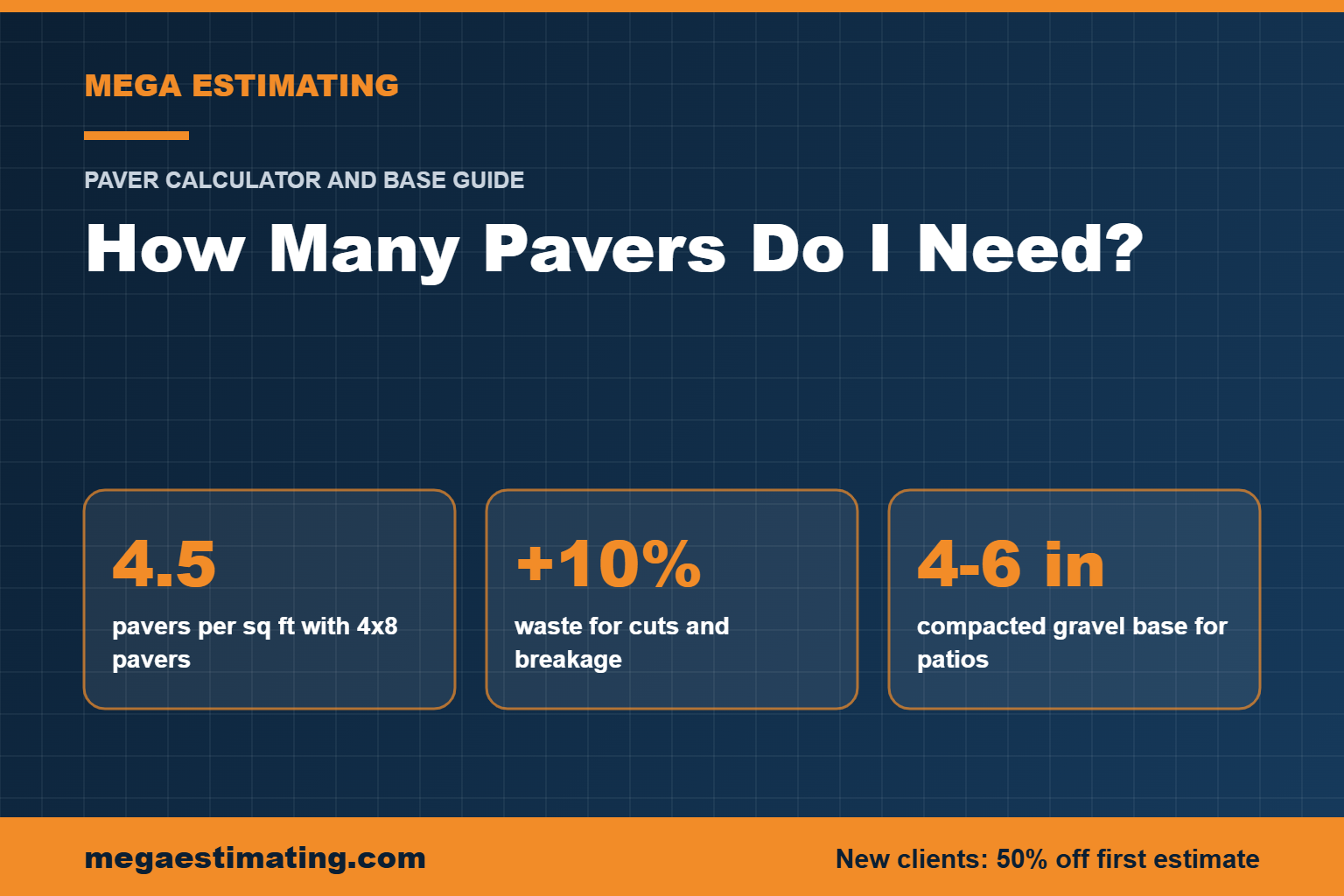
Pavers are sold by the piece or by the pallet, but patios, walkways and driveways are measured in square feet. If you are asking how many pavers do I need, the answer depends on three things: the area, the paver size and the laying pattern. This guide gives you the formula, a paver chart, a full patio example and the base materials that go underneath.
Pavers per Square Foot by Paver Size
Each paver covers a fixed area. Divide 144 square inches (one square foot) by the paver’s length times width in inches to get the count per square foot.
| Paver Size | Area per Paver | Pavers per Sq Ft |
|---|---|---|
| 4 x 8 in (standard brick paver) | 0.222 sq ft | 4.5 |
| 6 x 6 in | 0.25 sq ft | 4.0 |
| 6 x 9 in | 0.375 sq ft | 2.67 |
| 12 x 12 in | 1.0 sq ft | 1.0 |
| 16 x 16 in | 1.78 sq ft | 0.56 |
Many pavers are sold in multi-size “kits” or by the square foot on a pallet. In that case, use the supplier’s coverage per pallet instead of a piece count.
How to Calculate How Many Pavers You Need
Step 1: Measure the Area
For rectangles, multiply length by width in feet. For irregular shapes, split the area into rectangles and triangles, calculate each, and add them together. A circle is 3.14 x radius x radius.
Step 2: Divide by the Paver Area
Divide the total square feet by the area of one paver, or multiply by the pavers per square foot from the table above.
Step 3: Add Waste
Add 5% to 10% for simple running bond or basket weave layouts and 10% to 15% for herringbone, circles, curves and many cuts around steps or posts.
Paver Chart by Area
Counts include 10% waste and are rounded up.
| Area | 4 x 8 Pavers | 6 x 9 Pavers | 12 x 12 Pavers |
|---|---|---|---|
| 100 sq ft | 495 | 294 | 110 |
| 200 sq ft | 990 | 587 | 220 |
| 300 sq ft | 1,485 | 880 | 330 |
Worked Example: A 12 x 16 ft Patio
| Item | Calculation | Result |
|---|---|---|
| Patio area | 12 x 16 ft | 192 sq ft |
| 4 x 8 pavers | 192 x 4.5 | 864 |
| With 10% waste | 864 x 1.10 | 951 pavers |
| Gravel base, 4 in | 192 x 0.333 ft = 64 cu ft | 2.4 cu yd (about 3.3 tons) |
| Bedding sand, 1 in | 192 / 12 = 16 cu ft | 0.6 cu yd |
| Edge restraint | 2 x (12 + 16) | 56 linear ft |
Tonnage for crushed stone base is estimated at about 1.4 tons per cubic yard. Confirm the density with your supplier, since it varies by material.
Base, Sand and Edging You Need
- Compacted gravel base: about 4 inches for walkways, 4 to 6 inches for patios and 8 to 12 inches for driveways, compacted in layers.
- Bedding sand: about 1 inch of coarse concrete sand, screeded flat.
- Joint sand: polymeric sand swept into the joints after the pavers are set. Coverage depends on joint width, so check the bag.
- Edge restraints: plastic, metal or concrete edging around the full perimeter.
- Geotextile fabric: often used over soft or clay soils to keep the base from mixing with the subgrade.
Base and excavation are often a bigger cost than the pavers themselves, so include them in every estimate. Our guides on site preparation and hauling excavated soil cover that part of the job.
Common Paver Estimating Mistakes
- Forgetting waste. Cuts at edges and patterns always use extra pavers.
- Mixing pallet and piece counts. Some suppliers sell by square foot per pallet, not by piece.
- Thin base. Skimping on base depth leads to sinking and shifting pavers.
- No edge restraint. Pavers spread over time without it.
- Pricing material only. Excavation, base, compaction and labor often cost more than the pavers.
Frequently Asked Questions
How many pavers do I need per square foot?
With standard 4 x 8 inch pavers you need about 4.5 per square foot. A 6 x 6 paver needs 4 per square foot, a 6 x 9 paver about 2.67, and a 12 x 12 paver 1 per square foot.
How many pavers do I need for a 10×10 patio?
A 10 x 10 patio is 100 square feet, so you need about 450 standard 4 x 8 pavers, or about 495 with 10% waste.
How much waste should I add for pavers?
Add 5% to 10% for straight running or basket weave patterns and 10% to 15% for herringbone, circles or patios with many curves and cuts.
How deep should the gravel base be under pavers?
Plan about 4 inches of compacted base for walkways, 4 to 6 inches for patios and 8 to 12 inches for driveways, plus about 1 inch of bedding sand.
Do I need edge restraints for pavers?
Yes. Edge restraints hold the pavers and base in place. Measure the full perimeter of the area in linear feet to order them.
Need a Full Hardscape or Sitework Estimate?
A small patio is easy to count. Larger hardscape and sitework packages include excavation, base, drainage, pavers, curbs and labor. Mega Estimating measures every item from your plans and prices it for your bid. Mega Estimating is a U.S. construction estimating company that prepares quantity takeoffs and detailed cost estimates for residential, commercial and industrial contractors.
Get 50% Off Your First Estimate