
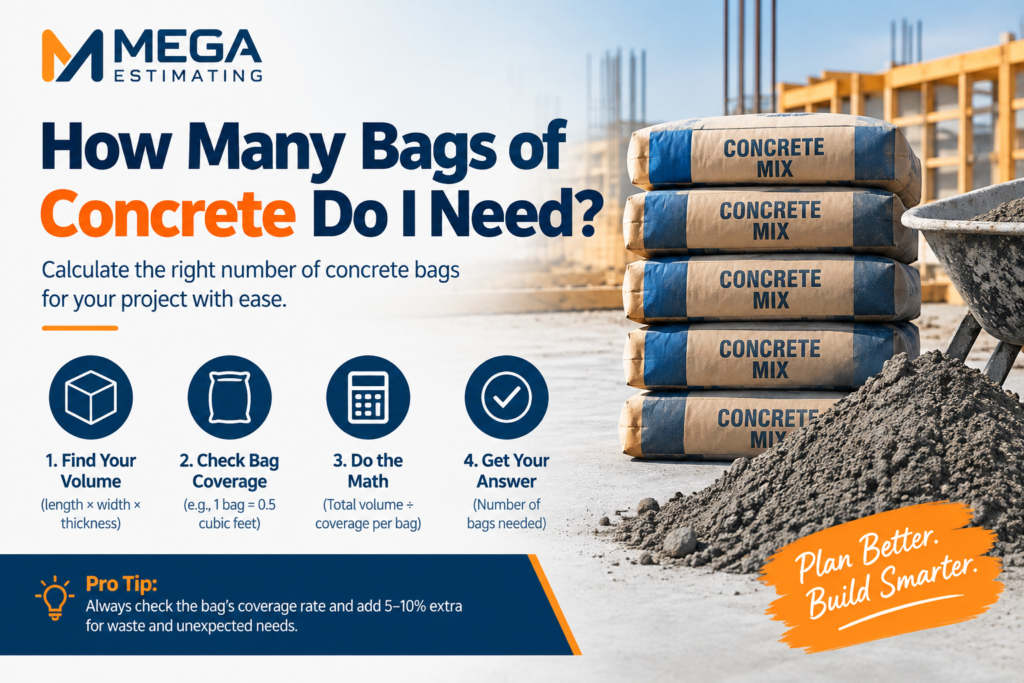
Whether you are setting fence posts, pouring a small patio or forming a footing, the first question is always the same: how many bags of concrete do I need? Buy too few and you stop mid-pour with a cold joint. Buy too many and you waste money and haul heavy bags back to the store.
This guide gives you the bag yields, a simple formula, ready-made charts and three worked examples, so you can get the number right the first time.
Pre-mixed concrete is sold by weight, but you pour it by volume. Each bag size produces a set volume of mixed concrete, called its yield. These are the standard yields printed on most U.S. bags:
| Bag Size | Yield per Bag | Bags per Cubic Yard | Bags per 10 sq ft at 4″ Thick |
|---|---|---|---|
| 40 lb | 0.30 cu ft | 90 | 11.1 |
| 50 lb | 0.375 cu ft | 72 | 8.9 |
| 60 lb | 0.45 cu ft | 60 | 7.4 |
| 80 lb | 0.60 cu ft | 45 | 5.6 |
Always check the label on the brand you buy, since high-strength or fast-setting mixes can yield slightly less per bag.
Multiply length × width × thickness, with every measurement in feet. Convert inches to feet by dividing by 12, so a 4-inch slab is 0.333 ft thick and a 6-inch slab is 0.5 ft thick.
For round holes such as fence posts, use π × radius² × depth, then subtract the volume of the post itself.
Divide the cubic feet by 0.60 for 80 lb bags, 0.45 for 60 lb bags or 0.30 for 40 lb bags. Round up to the next whole bag.
Add 5% to 10% for spillage, uneven subgrade and over-excavation. Use 10% for slabs on soil and 5% for formed work with clean, level forms.
Use this chart for common slab sizes. Numbers include 10% waste and are rounded up.
| Slab Area | Thickness | Volume | 80 lb Bags | 60 lb Bags |
|---|---|---|---|---|
| 4 × 4 ft (16 sq ft) | 4″ | 5.3 cu ft | 10 | 14 |
| 10 × 10 ft (100 sq ft) | 4″ | 33.3 cu ft | 62 | 82 |
| 10 × 10 ft (100 sq ft) | 6″ | 50.0 cu ft | 92 | 123 |
| 12 × 12 ft (144 sq ft) | 4″ | 48.0 cu ft | 88 | 118 |
| 10 × 20 ft (200 sq ft) | 4″ | 66.7 cu ft | 123 | 163 |
If you want to price the whole job, not just count bags, our concrete slab cost calculator guide walks through base, reinforcement and labor.
A 10 × 10 ft patio, 4 inches thick: 10 × 10 × 0.333 = 33.3 cu ft. Divided by 0.60 = 55.6, so 56 bags of 80 lb. Add 10% waste and you need 62 bags. The slab itself is about 1.23 cubic yards, which is close to the point where a ready-mix truck makes more sense (see below).
Each hole is 10 inches wide and 3 ft deep for a 4×4 post. Hole volume: 3.1416 × (0.417 ft)² × 3 = 1.64 cu ft. The post takes up 0.29 × 0.29 × 3 = 0.25 cu ft, leaving 1.39 cu ft of concrete. That is 2.3 bags of 80 lb, so plan 3 bags per post, or 4 bags of 60 lb.
A footing 20 ft long, 16 inches wide and 8 inches deep: 20 × 1.333 × 0.667 = 17.8 cu ft. Divided by 0.60 = 29.6 bags. With 5% waste in clean forms, order 32 bags of 80 lb.
Round forms are common for deck piers and porch columns. This table shows 80 lb bags per foot of depth, before waste:
| Tube Diameter | Volume per Foot | 80 lb Bags per Foot | 4 ft Pier (with 10% waste) |
|---|---|---|---|
| 8″ | 0.35 cu ft | 0.58 | 3 bags |
| 10″ | 0.55 cu ft | 0.91 | 4 bags |
| 12″ | 0.79 cu ft | 1.31 | 6 bags |
| 16″ | 1.40 cu ft | 2.33 | 11 bags |
Bagged concrete works well for small, spread-out pours. Once a pour reaches roughly one cubic yard (45 bags of 80 lb), ready-mix delivery is usually cheaper, faster and more consistent.
| Factor | Bagged Concrete | Ready-Mix Truck |
|---|---|---|
| Best for | Posts, steps, repairs, pours under 1 cu yd | Slabs, driveways, footings over 1 cu yd |
| Labor | High: lifting and mixing every bag | Low: concrete arrives mixed |
| Consistency | Varies batch to batch | Uniform strength and slump |
| Extra costs | Mixer rental, transport | Short-load and delivery fees |
Prices change by region, so compare a local quote for ready-mix (including short-load fees) with your bag total before you decide.
For larger projects, quantities usually come from the drawings rather than a tape measure. Our guide on how to calculate cubic yards of concrete covers footings, walls and columns.
About 45 bags. Each 80 lb bag yields 0.60 cubic feet, and a cubic yard is 27 cubic feet.
For a 4-inch slab, about 56 bags of 80 lb concrete, or 62 bags with 10% waste. A 6-inch slab needs about 92 bags with waste.
For a 4×4 post in a 10-inch hole, 3 ft deep, plan about 3 bags of 80 lb or 4 bags of 60 lb concrete.
Bags are usually cheaper for pours under one cubic yard. Above that, ready-mix is often cheaper once you count labor, mixer rental and time.
About 60 bags, since each 60 lb bag yields 0.45 cubic feet.
Counting bags works for a patio. For foundations, slabs and walls on a full plan set, Mega Estimating calculates every pour in cubic yards, adds rebar, formwork and waste, and prices the concrete package for your bid. Mega Estimating is a U.S. construction estimating company that prepares quantity takeoffs and detailed cost estimates for residential, commercial and industrial contractors.