
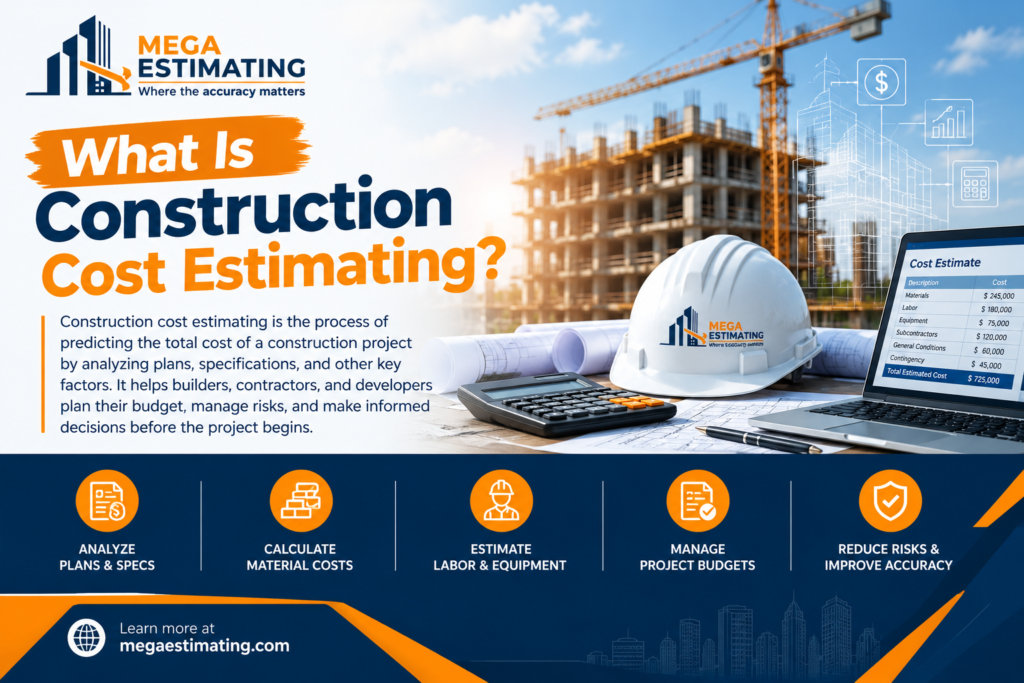
Construction cost estimating is the practice of calculating the expected cost of a building project using drawings, specifications, material prices, labor rates, equipment needs and business markups. The result is a document that shows how much the project should cost and where that money will go.
Estimates are used for many purposes. Owners use them to decide whether a project is affordable. Contractors use them to prepare bids. Lenders use them to approve financing. Project managers use them to control spending after the contract is signed.
A small error in a single line can become a large loss when it is repeated across a full project. Accurate estimating matters for several reasons.
Not every estimate has the same level of detail. The type you need depends on how far along the design is and what decision you are trying to make.
This early stage estimate is prepared when only basic ideas exist, such as building type, size and location. It helps owners judge feasibility before spending money on design.
Once a schematic design is available, a preliminary estimate adds more detail. It is used to compare design options and adjust the budget.
A detailed estimate is built from complete drawings and specifications. Every material, labor task and subcontractor scope is measured and priced. This is the type most contractors use to submit a firm bid.
A bid estimate is a detailed estimate that has been finalized with markups, taxes, bonds and other business factors, and is ready to submit to the owner.
When the scope changes during construction, a change order estimate prices the added or removed work so that both sides agree on the cost adjustment.
Estimators use several methods, and often combine them depending on the stage of the project.
This method uses the cost of a similar past project as a starting point and adjusts it for differences in size, location and quality. It is fast and useful early on, but it is not very precise.
Parametric estimating uses a cost per unit, such as cost per square foot, applied to the size of the project. It is popular for early budgets, especially in residential and commercial work. Accuracy depends on how good the unit cost data is.
In this method, the project is broken into work items, and each item is multiplied by a unit price, such as cost per cubic yard of concrete or cost per linear foot of pipe. It is common in civil and site work.
Bottom up estimating is the most detailed approach. The estimator measures every item, prices materials, labor and equipment separately, and adds them together. It takes more time but delivers the most reliable result for bidding.
Here, related items are grouped into assemblies, such as a complete wall with framing, insulation and drywall. This speeds up pricing while keeping a good level of accuracy.
A good estimate follows a clear order of work. Here is a simple process that most professionals use.
To see this process explained in an even more practical way, read our walkthrough on how to estimate construction costs.
Understanding the difference between these two cost groups is essential for accurate pricing.
Direct costs are expenses tied to a specific part of the work. These include materials, labor, equipment and subcontractor payments. If you remove that work from the project, those costs disappear.
Indirect costs support the project as a whole. These include site supervision, temporary power, insurance, permits, project management and office support. They do not belong to one task, but they still need to be paid. Many contractors lose profit because they price direct costs well and forget about indirect ones.
The same building can cost very different amounts in different places and at different times. Keep these factors in mind when preparing any estimate.
Even experienced teams make errors. Knowing the most common ones helps you avoid them.
Plans and specifications often contain details in different places. If they are not compared carefully, items get left out of the estimate and the cost shows up later as a loss.
An estimate built on old material prices can be wrong the day it is submitted. Always confirm current pricing, especially for volatile materials.
Materials like tile, drywall, lumber and roofing always include cutting loss and damage. Skipping waste factors leads to shortages and extra purchases.
Optimistic productivity assumptions are a classic problem. Weather, access, rework and coordination all slow down real crews.
Permits, temporary facilities, insurance and supervision are easy to overlook, yet they add up on every project.
No project goes exactly as planned. Leaving out a contingency means any surprise comes directly out of your profit.
A rushed estimate can contain simple addition errors or duplicated items. A second review is one of the cheapest ways to protect your margin.
The basic principles stay the same, but the details change with the project. Home building focuses on finishes, framing and room by room pricing, which is covered in our article on residential construction estimating. Larger buildings with many trades and systems need extra coordination, which you can explore in our guide to commercial construction estimating.
If you are bidding on several jobs at once, working with large plan sets, or entering a new trade or market, a professional estimator can save time and reduce risk. Outsourced teams provide trained eyes, organized processes and faster turnaround so you can bid more often with more confidence.
It is the process of calculating the expected cost of a construction project by measuring quantities and applying prices for materials, labor, equipment, subcontractors and business markups.
Bottom up estimating is generally the most accurate because it measures and prices each item separately. It takes more time, but it is the preferred method for firm bids.
Start with complete plan reviews, use current local prices, include waste and indirect costs, add a sensible contingency, and always run a final quality check.
An estimate is the calculated cost of the project. A bid is the price you offer the owner, which includes your markups, risk allowances and strategic business decisions.
It depends on the project size and complexity. Small jobs may take a few days, while large commercial projects can take much longer.
Construction cost estimating is both a science and a skill. The science is in the methods, data and process. The skill comes from experience, careful review and learning from every completed project. When you follow a clear process and avoid the common mistakes, your bids become sharper and your profits become more predictable.
If you want expert support for your next bid, explore our construction estimating services and get accurate numbers you can trust.
Our team covers every stage, from conceptual budgets to detailed bid estimates, for residential, commercial and industrial projects across the United States.
Mega Estimating is a U.S. construction estimating company that prepares quantity takeoffs, detailed cost estimates and bid support for residential, commercial and industrial contractors in all 50 states.