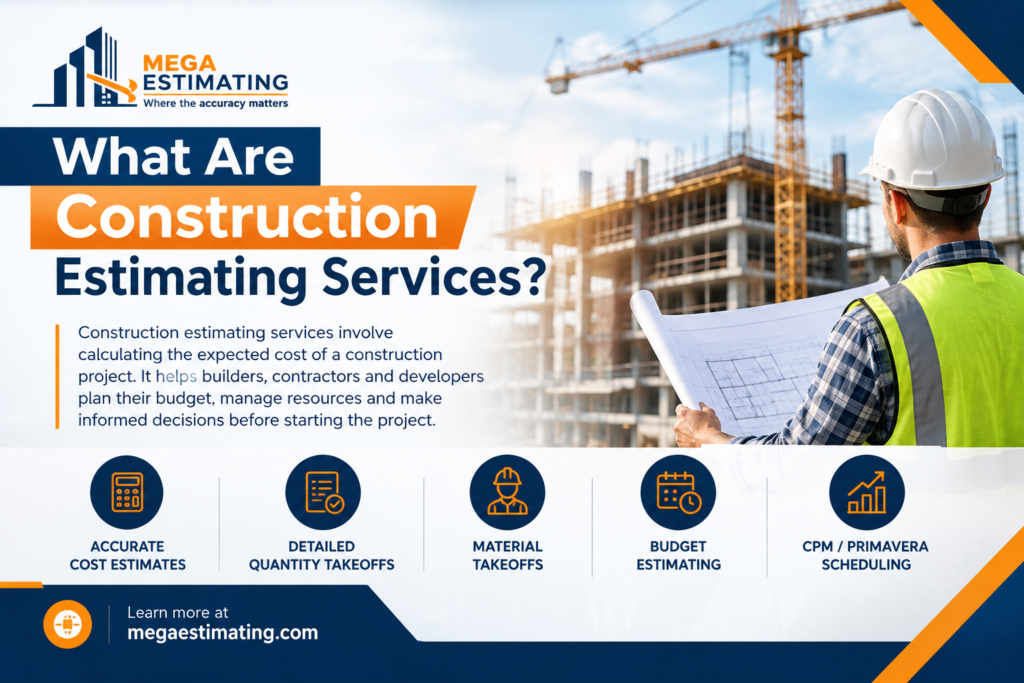
Construction estimating services are professional services where trained estimators review your project plans and specifications and prepare a detailed cost breakdown for the job. The estimate covers materials, labor, equipment, subcontractor work, overhead and profit, so you know the real cost of a project before you submit a bid.
These services are used by general contractors, subcontractors, home builders, remodelers, developers and even property owners who want a reliable budget. Instead of building an in house estimating team, many companies hand this work to an outside team that does it every day.
Estimating is time consuming. A single set of commercial drawings can take days to measure, price and review. When you are chasing several bids at once, that workload becomes a bottleneck. Outsourcing solves several problems at the same time.
A good estimate is more than a single total. It breaks the project into clear parts so you can understand every dollar. Here are the core components you should expect.
The takeoff is the foundation of every estimate. It measures the amount of each material and work item shown on the drawings, such as square feet of drywall, linear feet of framing or the number of electrical fixtures. If you want to understand this step in more detail, read our guide on material takeoff services and why contractors outsource them.
Once quantities are known, current material prices are applied. Good estimators account for waste factors, delivery costs and local price differences, because lumber, steel, concrete and finishes can change in price quickly.
Labor is calculated using productivity rates, crew size and local wage levels. A task that takes one crew a day in one city may take longer in another, so location matters.
Rentals, tools, scaffolding, lifts and specialty subcontractors are added to the estimate. Missing these items is one of the most common reasons bids come in too low.
Overhead covers your office costs, insurance, vehicles and project management time. Profit is what your business earns for taking on the risk. Contingency is a safety margin for surprises. A complete estimate shows all three clearly.
Not every project needs the same type of estimate. The right service depends on the size, trade and stage of your job.
Home builders and remodelers need estimates for new homes, additions, kitchens, bathrooms and renovations. These estimates focus on finishes, framing, roofing and detailed room by room pricing. You can learn more in our article on residential construction estimating.
Offices, retail spaces, warehouses, schools and healthcare buildings involve more systems, more trades and tighter schedules. Commercial estimates are larger and need careful coordination between structural, mechanical, electrical and plumbing scopes. Our guide to commercial construction estimating explains the process and best practices.
Subcontractors such as electricians, painters, drywall installers, roofers and HVAC companies often need estimates for only their own scope. A specialist who understands that trade can price it much more accurately than a general estimator.
Before final drawings are ready, owners and developers often need early budget numbers. Conceptual and preliminary estimates help them decide whether a project is financially realistic before design money is spent.
Costs differ a lot from one city to another. High cost markets like New York need estimators who understand local labor rates, union conditions, permit requirements and material delivery challenges. If you work in that market, read about construction estimating services in NYC and what contractors should look for.
While every company has its own workflow, most professional estimating services follow a similar path.
If you want to learn the logic behind these steps, our guides on construction cost estimating and how to estimate construction costs walk through the methods in detail.
This is a common question for growing contractors. Both options can work, but they suit different situations.
An in house estimator knows your company well and is always available, but the cost is fixed whether you have five bids or fifty. You also need to pay for software, training and benefits, and your whole bidding process depends on one person.
An outsourced service gives you access to a team, which means faster turnaround during busy periods and no cost when you have nothing to bid. The trade off is that you need to communicate clearly and choose a provider who understands your type of work.
Many contractors use a hybrid approach. They keep a small internal team for regular work and outsource overflow projects, specialized trades or large bids that need extra hands.
Not all providers deliver the same quality. Before you hire one, check the following points.
Even experienced contractors lose profit because of avoidable errors. Watch out for these common problems.
A professional estimating service reduces these risks because every estimate goes through a structured process and a final check.
Pricing depends on the size and complexity of the project, the number of trades involved, the level of detail needed and how fast you need the result. Small residential jobs usually cost far less than a large commercial building with many systems. Some providers charge a flat fee per project, while others price by plan pages, square footage or percentage of project value.
The best way to judge cost is to compare it with the value. One accurate estimate that helps you win a profitable job, or helps you avoid a losing one, can easily pay for itself many times over.
They typically include plan review, quantity takeoff, material and labor pricing, equipment and subcontractor costs, overhead and profit, and a final organized cost report that you can use for bidding.
General contractors, subcontractors, builders, remodelers, developers and property owners all use them, especially when they have many bids, tight deadlines or limited in house estimating staff.
Small projects can often be completed within a few days, while large commercial projects may take longer. Turnaround depends on the size of the plan set, the trades involved and how quickly questions are answered.
Yes. Most contractors use outsourced estimates as the cost basis for their bids. You should still review the estimate, add your own business factors and confirm that it matches your approach to the project.
No. Small contractors and growing businesses often benefit the most, because they can access expert estimating without hiring a full time employee.
Accurate numbers protect your profit, strengthen your bids and help you grow with confidence. Whether you build homes, manage commercial projects or run a specialty trade business, professional construction estimating services give you speed, accuracy and the freedom to focus on running your business.
If you are ready to bid smarter, explore our construction estimating services and get a detailed estimate for your next project. You can also read our related guides on construction cost estimating and how to estimate construction costs to build a stronger understanding of the process.
Contractors, builders and developers use our estimating services for accurate takeoffs, detailed cost breakdowns and fast turnaround on bids of every size.
Mega Estimating is a U.S. construction estimating company that prepares quantity takeoffs, detailed cost estimates and bid support for residential, commercial and industrial contractors in all 50 states.