
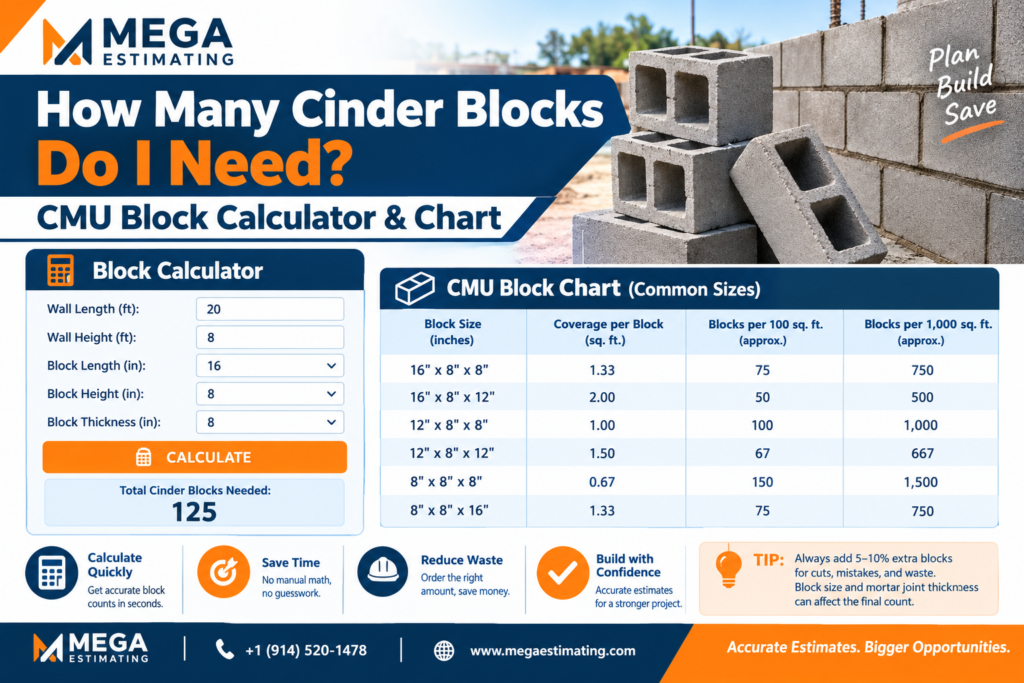
Concrete block walls go up fast, but only if the right number of blocks is on site. Short deliveries stop the mason crew, and extra pallets cost money to buy and return. If you are wondering how many cinder blocks do I need, the math is simpler than most people expect, because a standard block covers a fixed area of wall.
This guide explains block sizes, the formula, a quick chart and a worked example, plus mortar, rebar and the special blocks that are easy to forget.
Cinder Block Sizes
Most people say “cinder block,” but modern blocks are concrete masonry units (CMU). Block sizes are given as nominal dimensions, which include a 3/8 inch mortar joint. The actual block is 3/8 inch smaller in each direction.
| Nominal Size (W × H × L) | Actual Size | Face Area | Blocks per Sq Ft |
|---|---|---|---|
| 4 × 8 × 16 in | 3-5/8 × 7-5/8 × 15-5/8 in | 0.89 sq ft | 1.125 |
| 6 × 8 × 16 in | 5-5/8 × 7-5/8 × 15-5/8 in | 0.89 sq ft | 1.125 |
| 8 × 8 × 16 in (standard) | 7-5/8 × 7-5/8 × 15-5/8 in | 0.89 sq ft | 1.125 |
| 12 × 8 × 16 in | 11-5/8 × 7-5/8 × 15-5/8 in | 0.89 sq ft | 1.125 |
Because the face is the same 8 × 16 inches, the block count per square foot does not change with wall thickness. Thicker blocks change the weight, the grout and the price.
How to Calculate How Many Cinder Blocks You Need
Method 1: By Square Footage
Multiply wall length by wall height to get square feet, subtract openings, then multiply by 1.125.
Method 2: By Courses
Divide the wall length in inches by 16 to get blocks per course, then divide the height in inches by 8 to get the number of courses. Multiply the two. A 20 ft × 4 ft wall has 15 blocks per course and 6 courses, so it needs 90 blocks.
Add Waste
Add 5% for straight walls and up to 10% for walls with many corners, openings or cuts.
Cinder Block Chart by Wall Area
Standard 8 × 16 inch face, 5% waste included, rounded up.
| Net Wall Area | Blocks (No Waste) | Blocks with 5% Waste |
|---|---|---|
| 50 sq ft | 57 | 60 |
| 100 sq ft | 113 | 119 |
| 200 sq ft | 225 | 237 |
| 500 sq ft | 563 | 591 |
| 1,000 sq ft | 1,125 | 1,182 |
Worked Example: A Retaining Wall Along a Driveway
A block wall runs 40 ft long and 6 ft high, using 8 × 8 × 16 inch blocks with no openings.
| Item | Calculation | Result |
|---|---|---|
| Wall area | 40 × 6 ft | 240 sq ft |
| Blocks | 240 × 1.125 | 270 |
| Check by courses | 30 blocks × 9 courses | 270 |
| With 5% waste | 270 × 1.05 | 284 blocks |
Both methods give the same answer, which is a good habit for checking any takeoff. A retaining wall also needs a footing, drainage and an engineered design for its height, so treat this as a quantity example, not a structural design.
Mortar, Grout and Rebar
Mortar
For standard 8 inch block with face-shell mortar bedding, a common rule of thumb is about 8.5 cubic feet of mortar per 100 blocks. That is roughly 3 bags of masonry cement plus sand per 100 blocks, or about 12 to 14 bags of 80 lb pre-mixed mortar. Add 10% for waste.
Grout
Cells that contain vertical rebar, and any cells the engineer specifies, are filled with grout. Partially grouted walls only fill the reinforced cells, while fully grouted walls fill every cell. Count the grouted cells from the drawings, since grout volume can be a large part of the cost.
Rebar and Joint Reinforcement
Vertical bars are placed in cells at the spacing shown on the structural drawings, and horizontal joint reinforcement is often placed every second course. Include bond beam bars at the top of the wall and at floor lines.
Special Blocks You Need to Count Separately
- Half blocks: used at wall ends and openings in running bond.
- Corner blocks: have a finished end face for exposed corners.
- Bond beam blocks: U-shaped units that hold horizontal rebar and grout.
- Lintel blocks: span over doors and windows.
- Cap blocks: finish the top of garden and retaining walls.
- Pilaster blocks: thicken the wall at piers and columns.
Special units replace standard blocks in the count, so subtract them from your field-block total to avoid ordering both.
What Affects the Cost of a Block Wall?
- Block size and finish. Split-face and colored blocks cost more than standard gray units.
- Grouting and reinforcement. Fully grouted walls use much more grout and labor.
- Wall height. Scaffolding and bracing add cost on taller walls.
- Footings and drainage. These are often priced as separate line items.
- Mason productivity. Straight walls go up faster than walls with many corners and openings. See how to estimate labor costs.
Working with brick veneer as well? Our guide on how many bricks per square foot covers the face brick side of the wall.
Frequently Asked Questions
How many cinder blocks per square foot?
About 1.125 standard 8 × 16 inch blocks per square foot of wall, including the mortar joints.
How many cinder blocks do I need for a 100 square foot wall?
About 113 blocks, or 119 with 5% waste.
How many cinder blocks are on a pallet?
It varies by supplier and block size. Standard 8 inch block pallets commonly hold around 90 blocks, so confirm the count with your supplier.
Does wall thickness change the number of blocks?
No. 4, 6, 8 and 12 inch blocks all have an 8 × 16 inch face, so the count per square foot stays the same.
How much mortar do I need for cinder blocks?
As a rule of thumb, about 3 bags of masonry cement plus sand per 100 standard blocks, or about 12 to 14 bags of 80 lb pre-mixed mortar.
Need a Full CMU Takeoff?
Block walls involve more than field blocks. Mega Estimating counts every block type, grouted cell, bar and lintel from your structural and architectural drawings, then prices material and mason labor for your bid. Mega Estimating is a U.S. construction estimating company that prepares quantity takeoffs and detailed cost estimates for residential, commercial and industrial contractors.
Get a Free Quote