
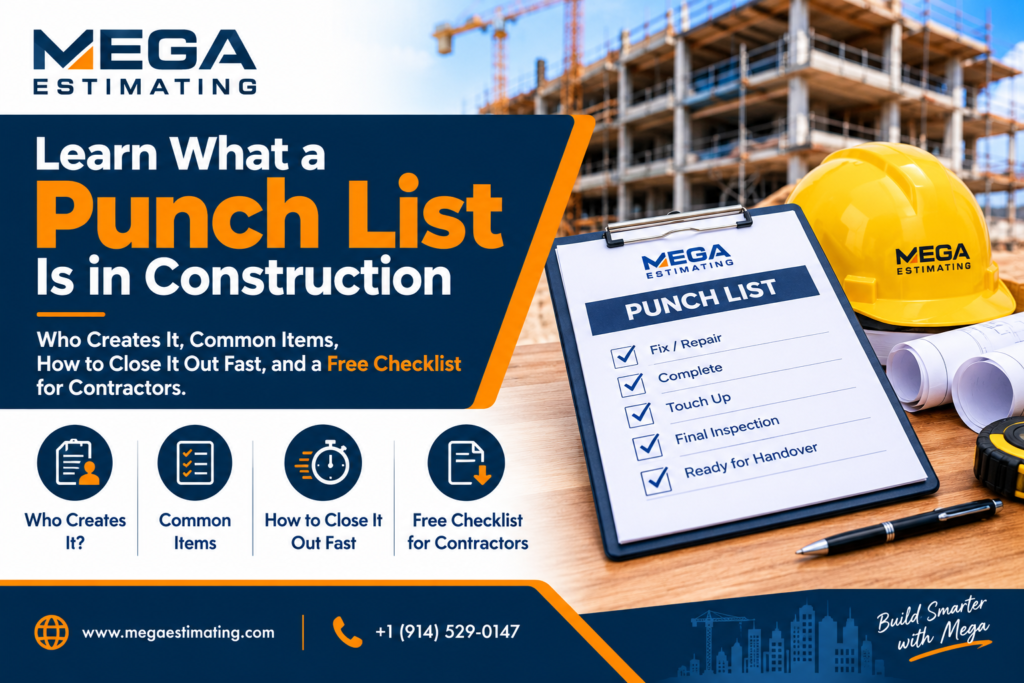
The building looks finished, the owner is ready to move in, and the final payment is in sight. Then comes the walkthrough, and with it a list of small items that still need attention. That list is the punch list. If you have wondered what is a punch list in construction, this guide explains who creates it, what goes on it, how to close it quickly and how to plan for it in your estimate.
What Is a Punch List in Construction?
A punch list (sometimes called a snag list or deficiency list) records every item that is incomplete, damaged or not built to the drawings and specifications at the end of a project. Each item names the location, the problem, the responsible trade and the date it is fixed.
The punch list marks the line between substantial completion, when the owner can use the building for its intended purpose, and final completion, when every contract requirement is met. Final payment and retainage are usually tied to closing it out.
Who Creates the Punch List?
| Party | Role |
|---|---|
| General contractor | Performs an internal pre-punch walk and fixes items before inviting the owner |
| Architect or engineer | Inspects the work against the drawings and specifications and issues the formal list |
| Owner or owner’s rep | Walks the project and adds items that affect use and appearance |
| Subcontractors | Receive their items, complete repairs and sign off |
Common Punch List Items
Most punch items are small, but together they can take weeks. Typical items by area include:
| Area | Typical Items |
|---|---|
| Finishes | Paint touch-ups, drywall dings, nail pops, scuffed walls |
| Doors and hardware | Doors that stick, missing stops, loose hinges, closers not adjusted |
| Flooring | Cracked tile, missing transitions, damaged carpet, base gaps |
| Electrical | Missing cover plates, fixtures not working, labels missing on panels |
| Plumbing and HVAC | Leaking fixtures, loose trim, unbalanced airflow, missing access panels |
| Exterior | Caulking gaps, damaged siding, landscaping, site cleanup |
The Punch List Process Step by Step
Step 1: Contractor Pre-Punch
The general contractor and trade foremen walk every room and fix obvious items before the formal inspection. A thorough pre-punch is the single best way to keep the official list short.
Step 2: Formal Walkthrough
The architect, owner and contractor inspect the project together. Items are recorded with photos, room numbers and responsible trades.
Step 3: Distribute to Trades
Each subcontractor receives only its items, with a deadline. Digital punch apps make it easy to assign, track and close items with photos.
Step 4: Complete and Verify
Trades fix their items and mark them complete. The contractor verifies each one before requesting a back-check.
Step 5: Back-Check and Sign-Off
The architect re-inspects. Once every item is closed, the project moves to final completion, final cleaning, closeout documents and release of retainage.
How to Shorten Your Punch List
- Inspect as you go. Quality checks after each phase catch problems before they are buried behind finishes.
- Protect finished work. Floor protection, corner guards and door covers prevent damage from later trades.
- Sequence trades carefully. Painting before electrical trim-out, for example, leads to touch-ups.
- Keep daily records. A good construction site diary shows who damaged what and when.
- Schedule final cleaning last. Cleaning before punch work only means cleaning twice. See our guide to post construction cleaning services.
Planning Punch List Work in Your Estimate
Punch work is real labor, and it happens when crews are winding down and supervision costs are still running. Experienced estimators plan for it:
- Carry a punch allowance. Base it on punch-out hours from your own past projects of similar size and type.
- Include supervision time. The superintendent often stays on site through the back-check.
- Price touch-up materials. Paint, caulk, ceiling tiles and spare finishes are needed for repairs.
- Account for retainage timing. A long punch list delays final payment. See retainage in construction.
Getting these items into the bid protects your margin at the very end of the job, when cost overruns are hardest to recover. Our building cost estimating team includes closeout costs in every detailed estimate.
Punch List Checklist for Contractors
- Pre-punch walk completed by GC and foremen
- All rooms labeled to match the drawings
- Photos and locations recorded for each item
- Items assigned to trades with due dates
- Touch-up materials and attic stock on site
- Back-check scheduled with the architect
- Final cleaning after punch work is complete
- Closeout documents ready for retainage release
Frequently Asked Questions
What is a punch list in construction?
A punch list is a document that lists incomplete, damaged or non-conforming work near the end of a project. All items must be fixed before final completion and final payment.
Who prepares the punch list?
The architect or owner’s representative usually issues the formal punch list after a walkthrough, but the general contractor should perform its own pre-punch first.
When is the punch list created?
At or near substantial completion, when the project is ready for the owner to use but small items remain.
How long does it take to complete a punch list?
It depends on project size and quality. Small projects may close in a few days, while large commercial jobs can take several weeks.
What is the difference between a punch list and a defect warranty?
Punch list items are fixed before final completion. Warranty items are defects that appear after the owner has accepted the project and moved in.
Include Closeout Costs in Every Bid
Punch work, final cleaning, supervision and touch-up materials are easy to miss on bid day. Mega Estimating builds detailed estimates that cover general conditions and closeout, so your margin survives to the final payment. Mega Estimating is a U.S. construction estimating company that prepares quantity takeoffs and detailed cost estimates for residential, commercial and industrial contractors.
Get a Free Quote